
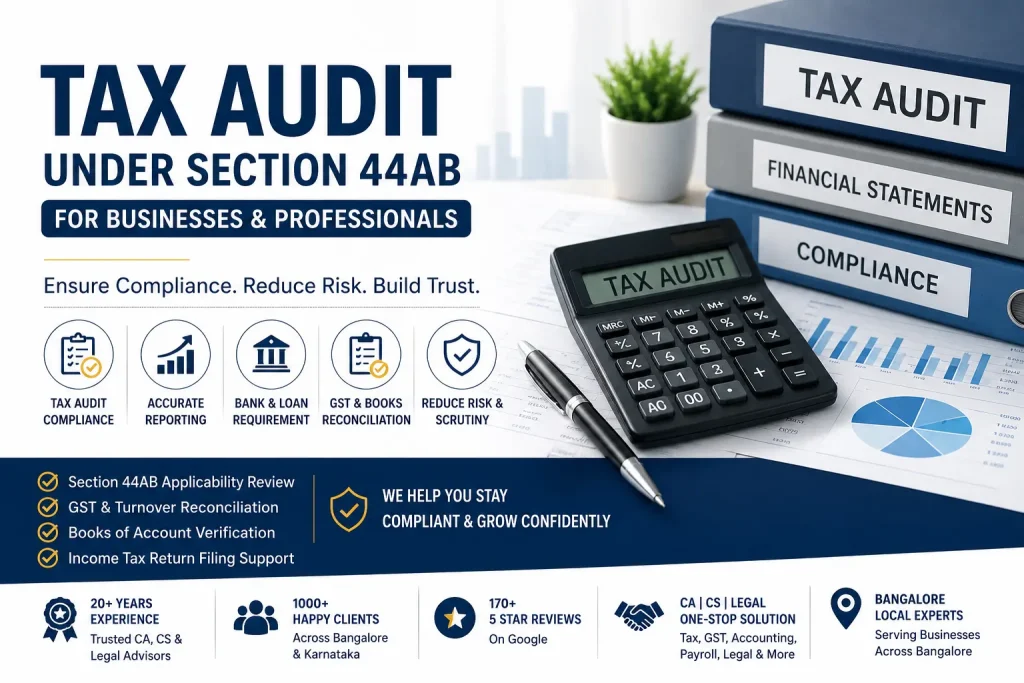
Do You Really Need a Tax Audit Before Filing Your Income Tax Return?
Many business owners discover the importance of a tax audit only when their Income Tax Return cannot be filed properly, a bank asks for audited financial statements, or they receive a clarification request regarding turnover, expenses, cash transactions, or GST reporting.
Under Section 44AB of the Income Tax Act, businesses and professionals crossing prescribed turnover or gross receipt limits may be required to obtain a tax audit report before filing their Income Tax Return. However, recent changes have created additional conditions relating to digital transactions, cash receipts, and cash payments which many taxpayers are unaware of.
A common misunderstanding is that turnover alone determines tax audit applicability. In reality, the nature of receipts, mode of payments, presumptive taxation provisions, banking transactions, and business structure also play an important role while determining whether a tax audit is mandatory.
Many businesses assume they qualify for tax audit exemption based on turnover limits alone. Later, during return filing or bank verification, they discover that cash transactions, investment entries, or other conditions have made tax audit compliance mandatory.
Important Tax Audit Changes for FY 2025-26 Every Business Should Know
The Income Tax Act provides a significant relaxation for businesses where cash receipts and cash payments do not exceed 5% of total receipts and payments. In such cases, the tax audit threshold may extend up to ₹10 Crore instead of the normal ₹1 Crore limit.
However, businesses dealing substantially in cash transactions may still fall under tax audit requirements even at much lower turnover levels. Retail traders, contractors, wholesalers, manufacturers, and businesses handling regular cash collections should review their position carefully before assuming they qualify for exemption.
Another important change for FY 2025-26 is increased disclosure requirements in Income Tax Returns, including additional reporting relating to investments, assets, income sources, and financial transactions. Taxpayers opting for presumptive taxation schemes must also ensure proper disclosure of financial information while filing returns.
The Income Tax Department has also intensified its use of AIS, TIS, and Nudge communications. Many taxpayers have recently received emails and SMS alerts requesting review of omitted income, unreported transactions, or mismatches appearing in departmental records.
Businesses should not wait until the return filing deadline. Early review of turnover, banking transactions, GST records, investments, and cash movements helps avoid last-minute audit complications and filing errors.
What Happens If You File an Income Tax Return Without Mandatory Tax Audit?
One of the most common mistakes made by businesses is filing an Income Tax Return without completing the required tax audit process. This usually happens because turnover calculations are misunderstood, cash transactions are overlooked, or audit applicability is not reviewed properly before filing.
When a tax audit is mandatory but not completed, the return may become defective, resulting in compliance complications, notice exposure, delayed processing, and additional scrutiny from the Income Tax Department.
In many cases, businesses only discover the issue when applying for bank loans, overdraft facilities, project financing, investor due diligence, or responding to departmental verification notices where audited financial statements are requested.
Apart from statutory consequences, incomplete audit compliance may also affect the credibility of financial statements and create practical difficulties in future business expansion, funding discussions, and regulatory verification processes.
A business files its return assuming audit is not applicable. Later, during bank loan processing or scrutiny review, turnover and cash transaction analysis indicate audit applicability, resulting in additional compliance work and avoidable delays.
Why Tax Audit Is No Longer Just a Compliance Requirement
Many business owners view tax audit only as a statutory requirement under the Income Tax Act. However, in practical business operations, a properly conducted tax audit serves a much larger purpose.
An audit helps verify whether accounting records, bank transactions, GST returns, sales figures, purchase records, expense claims, TDS credits, inventory valuation, and financial statements are properly aligned before Income Tax reporting.
Banks, financial institutions, investors, government departments, and business partners increasingly rely on audited financial statements when assessing the financial position and credibility of a business. Even where audit exemption may technically apply, many businesses voluntarily maintain audited records to strengthen financial transparency and future funding readiness.
A professionally managed tax audit often identifies turnover mismatch, unreconciled banking transactions, incorrect expense classification, GST inconsistencies, and disclosure gaps before they develop into larger compliance issues.
- Improve financial transparency
- Support bank loan applications
- Reduce scrutiny risks
- Strengthen GST reconciliation
- Improve accounting accuracy
- Verify turnover reporting
- Prepare for future funding and due diligence
- Maintain long-term compliance stability
Why Businesses Face Tax Audit Problems Even When Sales Are Properly Recorded
Most tax audit issues do not arise because businesses intentionally hide income or maintain incorrect records. In our practical experience, problems usually occur because sales, GST returns, banking transactions, TDS records, UPI collections, ecommerce settlements, and accounting books are maintained separately and are never reviewed together before return filing.
Today, the Income Tax Department receives information from multiple sources including GST returns, banks, payment gateways, TDS statements, property transactions, investment records, and AIS/TIS disclosures. Even small mismatches between these records may later trigger verification requests, notices, or scrutiny proceedings.
Many businesses focus only on preparing Profit & Loss accounts at year-end. However, turnover reporting, expense claims, GST reconciliation, TDS credits, and banking transactions must also align properly before a tax audit report is finalized.
Business owners often rely only on accounting software reports without verifying whether GST turnover, bank credits, UPI receipts, ecommerce collections, and Income Tax disclosures are matching properly.
Common Tax Audit Issues Identified During CA Review
A properly conducted tax audit often identifies discrepancies before they become larger compliance problems. Many issues are discovered only when books of account, GST records, and banking transactions are reviewed together.
Many of these issues can be corrected before filing the Income Tax Return if identified early. However, when ignored, they may later create scrutiny exposure, additional tax demands, penalty risks, or difficulties during bank verification and funding reviews.
GST Reconciliation and Tax Audit Must Work Together
One of the most important areas during tax audit is reconciliation between GST returns and financial statements. Businesses frequently file GST returns throughout the year but fail to ensure that reported turnover matches accounting records and Income Tax disclosures.
Differences between GSTR-1, GSTR-3B, audited financial statements, sales registers, and Income Tax turnover reporting may create unnecessary questions from tax authorities and increase compliance risks.
For GST-registered businesses, a proper tax audit review generally includes verification of sales turnover, GST liability, purchase records, input tax credit claims, debtor balances, and bank receipts to ensure consistency across all reporting systems.
Many Income Tax notices and GST clarification requests arise because turnover appearing in GST returns does not match turnover reported in books of account or Income Tax Returns.
If your business is GST registered, it is advisable to review GST reconciliation before finalizing accounts and filing the Income Tax Return. You may also review our detailed guide on Income Tax Notices to understand how mismatches are commonly identified by authorities.
How an Experienced Tax Auditor Reviews Books Before Filing the Return
A professional tax audit is not merely preparation of Form 3CA, 3CB, or 3CD. The real value comes from reviewing whether the financial records accurately reflect business transactions and whether disclosures are consistent across all reporting systems.
Before finalizing a tax audit report, experienced Chartered Accountants generally review sales records, purchase registers, bank statements, GST returns, cash transactions, expense classifications, TDS credits, debtor balances, creditor balances, and profitability trends.
This review process helps identify omissions, mismatches, and disclosure risks before the Income Tax Return is filed. It also improves financial transparency for banks, investors, government authorities, and future compliance requirements.
- GST vs Turnover Matching
- Bank Reconciliation Review
- Purchase & Sales Verification
- Expense Validation
- TDS Reconciliation
- AIS/TIS Verification
- Cash Transaction Review
- Inventory & Stock Analysis
- Profitability Review
- Compliance Risk Identification
Real Business Situations Where Tax Audit Becomes Critical
Many businesses initially view tax audit as an annual compliance exercise. However, the importance of a properly prepared tax audit usually becomes evident when applying for bank loans, facing scrutiny notices, onboarding investors, renewing credit facilities, or undergoing financial due diligence.
In recent years, we have seen businesses face difficulties because turnover disclosures, GST returns, banking transactions, and financial statements were not properly reconciled before filing their Income Tax Return.
Each category has different audit risks, documentation requirements, and reconciliation challenges. Early review helps avoid last-minute filing complications and future compliance exposure.
Why Banks Often Ask for Tax Audit Reports Even When Audit May Not Be Mandatory
One of the most common questions we receive from business owners is why banks request audited financial statements even when the business may technically qualify for tax audit exemption under Income Tax provisions.
Banks, NBFCs, and financial institutions often rely on audited financial statements to assess business turnover, profitability, repayment capacity, financial discipline, and creditworthiness before approving loans, overdrafts, working capital facilities, or project funding.
Many businesses crossing significant turnover levels voluntarily maintain audited books because audited financial statements provide greater credibility during financial verification and lending processes.
Several businesses approaching banks for term loans, OD facilities, machinery finance, vehicle loans, or working capital limits are often asked to submit audited financial statements even where statutory audit exemption may otherwise be available.
Income Tax Nudge Notices, AIS Mismatch & Why Audit Accuracy Matters More Than Ever
The Income Tax Department has significantly increased the use of technology-based compliance monitoring through AIS (Annual Information Statement), TIS (Taxpayer Information Summary), and automated Nudge communications.
Many taxpayers have recently received SMS alerts and emails highlighting differences between departmental records and information disclosed in Income Tax Returns. These communications commonly relate to bank interest, investments, property transactions, securities transactions, high-value purchases, business receipts, and other financial activities.
For FY 2025-26, businesses should ensure that all income sources, investments, assets, and financial disclosures are properly reviewed before filing returns. Tax audit review plays an important role in identifying omissions or inconsistencies before they attract departmental attention later.
If the Income Tax Department already possesses information through AIS, TIS, GST records, banks, or other reporting entities, omission of such transactions in the return may increase the possibility of verification requests or future scrutiny proceedings.
You may also review our detailed resources on:
How Team IN Filing Helps Businesses Complete Tax Audit Safely
At Team IN Filing, tax audit support is approached as a complete reconciliation and compliance review process rather than merely preparing audit reports. The objective is to identify mismatch risks before notices, loan verification issues, or scrutiny complications arise.
Our team of Chartered Accountants, Company Secretaries, and legal professionals reviews books of account, GST returns, banking transactions, turnover reporting, TDS records, expense claims, inventory records, and financial statements together before finalizing the audit process.
This practical approach helps businesses maintain stronger financial transparency, reduce compliance risks, improve loan readiness, and ensure smoother Income Tax Return filing.
- Section 44AB Applicability Review
- GST & Turnover Reconciliation
- Bank Statement Verification
- Cash Transaction Analysis
- Purchase & Sales Matching
- TDS Reconciliation
- AIS/TIS Review
- Inventory Verification
- Financial Statement Finalization
- Tax Audit & ITR Filing Support
With more than 20 years of experience supporting Bangalore businesses, startups, contractors, traders, manufacturers, ecommerce sellers, and professionals, Team IN Filing focuses on practical compliance solutions that help businesses avoid future complications rather than reacting after notices are received.
Need a review of your tax audit applicability or books of account before filing your return? Our CA office can help assess turnover, GST records, banking transactions, and compliance position before the filing deadline.
Documents Commonly Required for Tax Audit Under Section 44AB
One of the biggest reasons for tax audit delays is incomplete documentation. Businesses often maintain records across GST portals, accounting software, bank accounts, and spreadsheets, making reconciliation difficult during the final audit review.
Keeping records organized before the audit process helps avoid last-minute corrections, turnover mismatch issues, and filing delays.
Frequently Asked Questions – Tax Audit under Section 44AB
Who is required to undergo Tax Audit under Section 44AB?
Businesses and professionals crossing prescribed turnover or receipt limits under the Income Tax Act may require tax audit before filing their Income Tax Return.
Can I avoid Tax Audit if my turnover exceeds ₹1 Crore?
Possibly. If cash receipts and cash payments do not exceed 5% and digital transactions exceed 95%, the higher threshold of ₹10 Crore may apply, subject to conditions.
What happens if I file ITR without mandatory Tax Audit?
The return may become defective, attract compliance issues, and create difficulties during scrutiny, loan verification, or future assessments.
Why is GST reconciliation important during Tax Audit?
GST turnover, books of account, and Income Tax disclosures should generally match to reduce mismatch notices and compliance risks.
Can banks ask for audited financial statements?
Yes. Many banks and financial institutions request audited financial statements while processing loans, overdrafts, and credit facilities.
Can Income Tax Department identify omitted transactions?
Yes. AIS, TIS, GST data, bank reporting, and other information sources help the department identify differences between reported and available information.
About the Author

Damodharaa R
CA | CS | Legal Advisor
Damodharaa R has more than 20 years of practical experience in Income Tax, GST, Tax Audit, Accounting, MCA Compliance, Trademark, and Business Advisory Services. He has assisted startups, SMEs, contractors, ecommerce sellers, manufacturers, professionals, and growing businesses across Bangalore with compliance management and financial reporting.
Supported by Sreedhara S, Satish, Mahesh S, and Prakasha, Team IN Filing provides integrated CA, Company Secretary, GST, Taxation, Accounting, Payroll, Trademark, and Legal Advisory Services across Bangalore and Karnataka.
Last Updated: May 2026
Need Tax Audit Support in Bangalore?
Tax Audit today is not only about complying with Section 44AB. Proper reconciliation of GST turnover, banking transactions, TDS credits, purchases, sales, inventory, and financial statements helps businesses reduce scrutiny exposure and maintain long-term compliance stability.
If you are unsure whether Tax Audit applies to your business, or if you want a review of turnover, cash transactions, GST records, or books of account before filing your return, Team IN Filing can help.
Team IN Filing – CA, CS & Legal Advisory Office
Sahakar Nagar, Bangalore – 560092
📞 7019827351 | 8792858436
📧 team@teamindia.co.in