
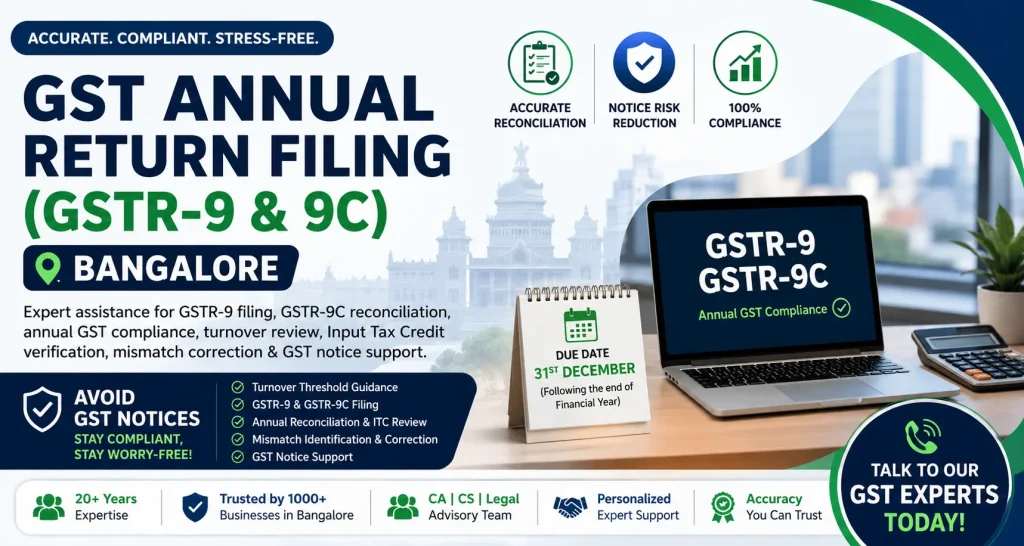
Looking for GST Annual Return Filing support in Bangalore? Businesses handling GSTR-9 filing, GSTR-9C reconciliation, annual turnover verification, Input Tax Credit review, and GST compliance often require structured year-end reconciliation and mismatch correction support.
GST Annual Return Filing (GSTR-9 & 9C) Bangalore for Year-End Compliance
Many businesses complete monthly GST filing regularly but later face complications during GST annual return filing because yearly reconciliation, turnover verification, Input Tax Credit review, vendor mismatch analysis, and audit applicability are not properly monitored throughout the financial year.
At Team IN Filings, our Bangalore GST advisory team regularly assists startups, contractors, ecommerce sellers, LLPs, private limited companies, manufacturers, restaurants, and service businesses with GSTR-9 filing, GSTR-9C compliance, annual GST reconciliation, mismatch correction, and GST notice handling support.
Recently, a Bangalore-based trading business approached our GST compliance team after receiving departmental queries during annual GST review because outward supply reporting and Input Tax Credit reconciliation did not properly match year-end records. After reconciliation restructuring and annual compliance review support, the mismatch exposure was addressed systematically.
GST Annual Return Services Commonly Required by Businesses
Preparation and filing support for annual GST returns involving turnover verification and yearly compliance review.
Annual reconciliation assistance involving books of accounts, GST filings, and turnover comparison review.
Input Tax Credit mismatch analysis, vendor reconciliation, and correction review support before annual filing.
Practical support for annual reconciliation notices, mismatch clarification, and GST compliance review matters.
Several GST notices arise during annual compliance review because businesses focus only on monthly return filing while ignoring year-end reconciliation consistency and turnover verification accuracy.
GSTR-9 & GSTR-9C Applicability Based on Turnover Threshold & Annual GST Compliance
The applicability of GSTR-9 Annual Return and GSTR-9C Reconciliation Statement mainly depends on the business’s Aggregate Annual Turnover calculated on PAN basis. Many businesses face GST notices, Input Tax Credit mismatch, and reconciliation issues because annual turnover review and GST compliance verification are not properly handled during year-end filing.
At Team IN Filings, our Bangalore GST advisory team regularly assists businesses with annual GST reconciliation, GSTR-9 filing, GSTR-9C review, turnover verification, mismatch correction, and GST notice risk management.
Turnover Up to ₹2 Crore – GSTR-9 Generally Optional
Businesses having Aggregate Annual Turnover up to ₹2 Crore are generally exempted from mandatory GSTR-9 filing, subject to applicable GST notifications and conditions.
However, many businesses voluntarily complete annual GST reconciliation to identify Input Tax Credit mismatch, vendor non-compliance, and turnover reporting inconsistencies before future scrutiny.
Several Bangalore startups voluntarily file annual GST returns to maintain better compliance records for banking and investor review purposes.
Turnover ₹2 Crore to ₹5 Crore – GSTR-9 Mandatory
Businesses having Aggregate Annual Turnover exceeding ₹2 Crore generally require mandatory filing of GSTR-9 Annual Return.
This annual return consolidates GSTR1, GSTR3B, tax liability, Input Tax Credit utilization, and yearly turnover reporting filed during the financial year.
GSTR-9 becomes mandatory, while GSTR-9C reconciliation is generally not applicable within this turnover category.
Turnover Above ₹5 Crore – GSTR-9 & 9C Mandatory
Businesses having Aggregate Annual Turnover exceeding ₹5 Crore generally require both:
- GSTR-9 Annual Return
- GSTR-9C Self-Certified Reconciliation Statement
GSTR-9C involves reconciliation between books of accounts, financial statements, GST returns, turnover disclosures, and Input Tax Credit claims.
Several GST notices involving turnover mismatch and Input Tax Credit discrepancies arise during GSTR-9C reconciliation review stages.
Important Due Dates & Compliance Points
The standard due date for annual GST return filing is generally 31st December following the close of the financial year, subject to extensions notified by GST authorities.
Businesses registered under the Composition Scheme generally file GSTR-4 instead of GSTR-9 annual return.
Several businesses postpone annual reconciliation until the deadline period, which increases the risk of mismatch errors, vendor inconsistency, and GST scrutiny exposure.
Businesses conducting quarterly GST reconciliation generally face significantly fewer annual filing complications and notice risks.
Annual GST Reconciliation, Mismatch Notices & Compliance Risk Review
Many businesses file GSTR-9 and GSTR-9C without properly reviewing yearly reconciliation differences between books of accounts, GST returns, vendor reporting, Input Tax Credit claims, and outward supply disclosures. These inconsistencies frequently create GST notices and future departmental scrutiny exposure.
Mismatch Between GSTR1, GSTR3B & Books of Accounts
One of the most common annual GST compliance issues occurs where turnover reported in GSTR1, tax liability declared in GSTR3B, and financial records maintained in books of accounts do not properly reconcile during year-end review.
Several businesses discover these inconsistencies only while preparing annual GST return filing or responding to reconciliation-based GST notices.
Input Tax Credit (ITC) Mismatch During Annual Review
Vendor non-compliance, delayed invoice reporting, duplicate claims, incorrect tax classification, or reconciliation gaps often create Input Tax Credit mismatch exposure during annual GST reconciliation.
Recently, a Bangalore-based manufacturing business approached Team IN Filings after annual GST reconciliation revealed significant Input Tax Credit differences caused by vendor filing inconsistencies and invoice mapping errors across multiple months.
GST Notices After Annual Filing Review
GST authorities increasingly use annual reconciliation systems to identify turnover mismatch, tax liability inconsistency, suspicious Input Tax Credit patterns, and reporting irregularities for further departmental verification.
Common Annual GST Compliance Mistakes Businesses Make
Several businesses complete GSTR-9 filing without properly reconciling monthly filings and yearly turnover records.
Vendor filing inconsistency often creates year-end Input Tax Credit mismatch complications.
Wrong classification or reconciliation entries may create future GST scrutiny exposure.
Businesses frequently postpone reconciliation review until the filing deadline, increasing mismatch risk.
Annual GST filing should not be treated as only a compliance formality. Proper reconciliation review helps businesses reduce future notice exposure and improve long-term GST compliance accuracy.
Why Annual GST Scrutiny Is Increasing for Businesses
GST authorities now use technology-driven reconciliation systems to compare annual returns, monthly filings, Input Tax Credit utilization, turnover declarations, vendor compliance, and financial reporting consistency. Businesses therefore require more structured annual GST compliance review compared to earlier years.
Frequently Asked Questions About GSTR-9 & GSTR-9C Filing in Bangalore
Businesses handling annual GST compliance, turnover reconciliation, GSTR-9 filing, and GSTR-9C review often have practical concerns regarding applicability, due dates, mismatch notices, and annual reconciliation exposure. Below are some commonly handled annual GST filing questions by our Bangalore GST advisory team.
GSTR-9 applicability generally depends on Aggregate Annual Turnover, taxpayer category, and applicable GST notifications. Businesses crossing prescribed turnover thresholds generally require annual GST return filing compliance.
Businesses having Aggregate Annual Turnover exceeding prescribed GST thresholds generally require filing of GSTR-9C self-certified reconciliation statement along with annual GST compliance review.
Annual reconciliation mismatch involving turnover reporting, Input Tax Credit claims, vendor compliance, or tax liability disclosure may create GST notice exposure or future departmental scrutiny risks.
Yes. Several businesses voluntarily complete annual GST filing to maintain stronger compliance records, improve banking credibility, and identify reconciliation inconsistencies early.
The standard due date for annual GST return filing is generally 31st December following the close of the financial year, subject to extensions notified by GST authorities.
Yes. Team IN Filings regularly assists Bangalore businesses with annual GST reconciliation, GSTR-9 filing, GSTR-9C review, turnover verification, mismatch correction, GST notices, and year-end compliance management.
Need GSTR-9 or GSTR-9C Filing Support in Bangalore?
Our Bangalore GST advisory team assists businesses with annual GST reconciliation, turnover review, GSTR-9 filing, GSTR-9C compliance, Input Tax Credit verification, mismatch correction, and GST notice support.

Damodharaa R
This GST annual return filing guidance content is reviewed and updated by Damodharaa R along with the Team IN Filings advisory team consisting of experienced CA, CS, GST practitioners, and legal professionals assisting Bangalore businesses with annual GST compliance and reconciliation matters for more than two decades.
Team IN Filings regularly assists startups, contractors, ecommerce sellers, LLPs, private limited companies, restaurants, manufacturers, and service businesses with GSTR-9 filing, GSTR-9C reconciliation, annual turnover verification, Input Tax Credit review, mismatch correction, GST notices, and year-end compliance management.
Team IN Filings – Bangalore GST Annual Return Consultant Office
Sahakar Nagar, Bangalore – 560092
Business Areas Regularly Assisted:
Hebbal | Whitefield | HSR Layout | Electronic City | Manyata Tech Park | Yelahanka | JP Nagar
Working Hours:
Monday to Saturday – 11:00 AM to 8:00 PM
Client Support:
📞 7019827351
📧 team@teamindia.co.in