
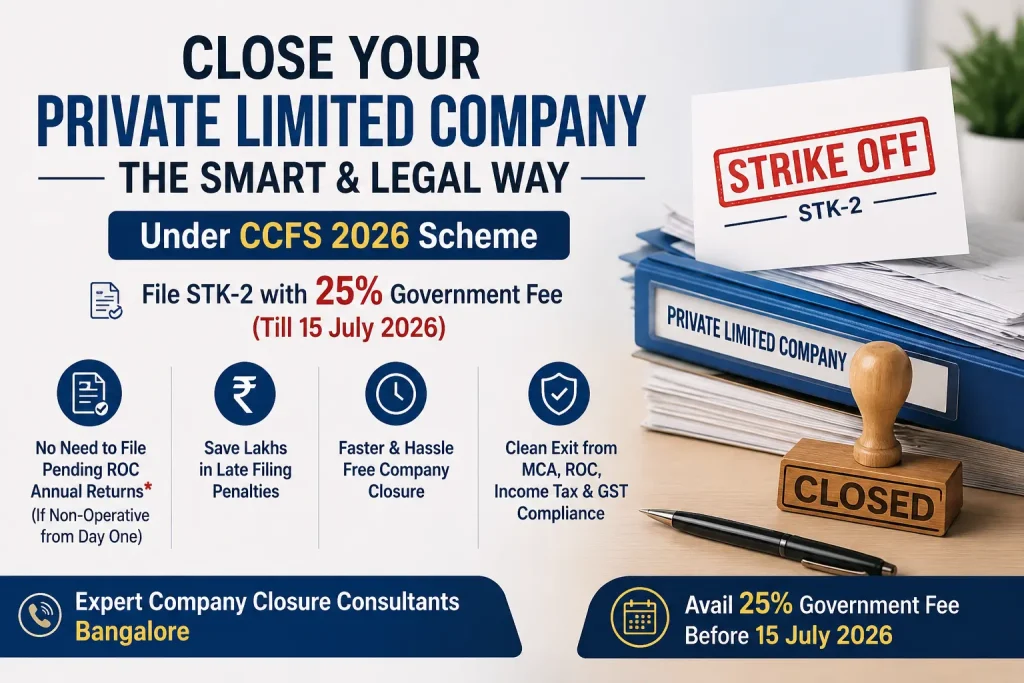
Private Limited Company Closure Without ROC Annual Return Filing – CCFS 2026
Your company never started business? You may not have to spend lakhs of rupees on pending ROC’s Aoc 4, Mgt 7 annual filings before applying for company strike off. Under the CCFS 2026 Scheme, eligible non-operative companies can apply for closure through STK-2 with only 25% Government filing fee before 15 July 2026. For companies that remained non-operative from incorporation, a properly drafted affidavit and supporting declarations may help avoid unnecessary ROC annual return filings for those non-operative years, subject to ROC review.
₹10,000 Today Can Save You Lakhs Tomorrow
Many directors believe they must first clear every pending ROC return before closing the company. In suitable non-operative cases, that assumption may not be correct. A proper review can save substantial compliance costs.
What Changed Under CCFS 2026?
The biggest relief is not just the reduced Government fee. The practical benefit is that ROC now examines whether the company actually carried on business. If the company remained non-operative from day one, the closure process can become much simpler with proper documentation.
One Line in the ROC Review Changed Everything
The ROC review states that pending annual filings should be completed “till the company was operative.” These few words are extremely important because they distinguish an inactive company from one that never commenced business.
Never Started Business?
If your company never issued invoices, never generated turnover, never employed staff and never carried on business, your case deserves a professional review before spending money on multiple years of ROC filings.
Don’t Pay Penalties Without Reviewing Your Case
Many directors spend lakhs of rupees on annual filing penalties simply because they assume there is no alternative. Every company’s facts are different. A proper legal review should always come first.
Who Can Use This Benefit?
- Company incorporated but never started business
- No turnover
- No GST transactions
- No employees
- No business bank activity
- No assets or liabilities
- Directors want to close the company legally
How Much Government Fee Is Payable?
Until 15 July 2026, STK-2 Government filing fee is available at only 25% of the normal fee under the CCFS 2026 Scheme. Once the scheme ends, normal fees are expected to apply.
What Documents Are Normally Required?
- Director Affidavit
- Indemnity Bond
- Board Resolution
- Director Consent Letter
- Bank Closure Letter
- GST Closure (if applicable)
- Income Tax Declaration or Acknowledgement
- Auditor Certified Statement of Accounts with UDIN
- PAN & Aadhaar of Directors
The Affidavit Is the Most Important Document
The affidavit should clearly explain when the company was incorporated, whether business ever commenced and the exact period during which it remained non-operative. A properly drafted affidavit helps ROC understand the actual facts of the case.
Real Case We Recently Reviewed
One of our Bangalore clients incorporated a private limited company but never commenced operations because the proposed project was cancelled. The directors believed they first had to spend a large amount on pending ROC annual filings. After reviewing the company’s records and preparing the appropriate declarations, the closure application was structured based on its actual operational history instead of assumptions.
How Long Does Company Closure Take?
Document preparation usually takes around 7 days. After STK-2 is filed, MCA generally takes around 30–60 days to process the strike off application.
Professional Fees
Professional Fees: ₹10,000 onwards
Government Fees: As applicable under the CCFS 2026 Scheme.
Before Spending on ROC Penalties, Get Your Company Reviewed
A 15-minute review may save years of unnecessary compliance costs. We first determine whether the company was actually operative before advising the next legal step.
✓ Company Closure Review
✓ ROC Compliance Review
✓ STK-2 Filing
✓ Affidavit & Indemnity Drafting
✓ Income Tax & GST Closure Assistance
Why Directors Across Bangalore Choose Us
With over 20 years of experience in MCA, ROC, GST, Income Tax and Company Law compliance, our team has helped hundreds of business owners resolve complex compliance issues with practical solutions rather than unnecessary filings.
Contact Team IN Filings for Close Private Limited Company
Phone: 7019827351
Email: team@teamindia.co.in
Office: Sahakar Nagar, Bengaluru – 560092
Why This CCFS 2026 Scheme Is a Big Relief for Company
For years, thousands of Private Limited Companies remained inactive because the business never took off. Unfortunately, the legal compliance obligations continued every year, even though there was no business activity.
Many directors later discovered that pending ROC annual returns, Income Tax filings and other compliances had accumulated over several financial years. The additional filing fees alone often became higher than the actual investment made in the company.
That is exactly where the CCFS 2026 Scheme provides practical relief.
Instead of assuming every inactive company must first complete all pending ROC filings, the Registrar of Companies now examines an important question—did the company actually carry on business?
If the company remained non-operative from the date of incorporation and there were no business transactions, the case deserves a proper legal review before spending money on unnecessary ROC filings.
The Biggest Benefit Is Not the Discount
Most people think the scheme is only about paying 25% Government filing fees for STK-2.
The real advantage is much bigger.
Eligible companies that never commenced business may avoid filing several years of ROC annual returns for the non-operative period, subject to ROC verification and proper supporting documents.
For many directors, this can result in savings of thousands—or even lakhs—of rupees in avoidable compliance costs.
A Small Review Today Can Save a Large Compliance Cost
Many business owners immediately start preparing pending AOC-4, MGT-7 and other ROC forms because someone advised that every default must be completed first.
However, every company has a different history. Some companies operated for several years, while others never started business at all.
That difference can completely change the closure strategy.
Before filing any pending returns, an experienced CA or Company Secretary should first review the incorporation records, bank statements, GST status, Income Tax position and actual business activities.
This simple review often determines whether the company qualifies for a straightforward strike-off application or requires completion of pending statutory filings.
Can You Close Your Company Without Filing Previous ROC Annual Returns?
The answer depends on one simple question — Did your company actually start business?
Many directors assume that every private limited company must complete all pending ROC annual returns before filing STK-2. In practice, the first step is to examine whether the company was ever operational.
Your Company May Be Eligible If…
✔ Business never commenced after incorporation.
✔ No sales invoices were raised.
✔ No purchase transactions took place.
✔ No employees were appointed.
✔ No commercial business activities were carried on.
✔ Bank account remained inactive or had only incorporation-related transactions.
✔ GST registration was never obtained or remained unused.
✔ The company has no assets and no outstanding liabilities.
✔ Directors now wish to legally close the company.
When Previous ROC Filings May Still Be Required
If the company actually carried on business, even for a limited period, ROC may require annual returns and financial statements to be filed up to the financial year in which the company remained operative.
Every strike-off application is therefore based on the company’s actual operational history, not merely the incorporation date.
A Small Difference Can Save Lakhs
There is a significant legal difference between:
• A company that never started business.
• A company that started business and later stopped.
This distinction often determines whether previous ROC annual filings become necessary before applying for strike-off.
That is why every case should be professionally reviewed before filing old ROC forms.
Our First Step Is Always a Compliance Review
Before preparing STK-2, we review the complete history of the company instead of making assumptions.
This includes:
- Certificate of Incorporation
- Bank Statement Review
- ROC Filing History
- GST Registration Status
- Income Tax Compliance Position
- Business Transactions, if any
- Assets and Liabilities
- Director’s Declaration
Only after this review do we advise whether the company can proceed directly for strike-off or whether certain pending compliances should first be completed.
Our Advice
Do not spend money filing old ROC returns simply because someone told you to.
First understand your company’s actual legal position. A professional review may identify a more practical and cost-effective closure route based on the facts of your case.
Our Step-by-Step Company Closure Process
Closing a private limited company is not just about filing Form STK-2. The success of the application depends on presenting the company’s actual facts correctly before the Registrar of Companies (ROC).
Our team follows a structured process so that unnecessary ROC filings and avoidable delays can be prevented wherever legally permissible.
Step 1 – Review the Company’s History
We first verify whether the company actually commenced business or remained non-operative from incorporation.
This review includes ROC records, bank transactions, GST status, Income Tax position and statutory compliance history.
Step 2 – Decide the Correct Legal Route
Every inactive company is different.
If the company never carried on business, we evaluate whether the strike-off application can be prepared based on the company’s actual non-operative status.
If business was carried on for any period, we identify the compliances that should be completed before filing STK-2.
Step 3 – Prepare Supporting Documents
Once the legal position is confirmed, we prepare all supporting documents required for the strike-off application.
- Director’s Affidavit
- Indemnity Bond
- Board Resolution
- Consent of Directors
- Statement of Accounts certified by Chartered Accountant with UDIN
- Bank Closure Proof
- GST Closure Documents, wherever applicable
- Income Tax Declaration or Acknowledgement, as applicable
Step 4 – File STK-2 with MCA
After verifying every document, Form STK-2 is filed with the Ministry of Corporate Affairs.
During the CCFS 2026 Scheme period, eligible companies can also avail the reduced Government filing fee available up to 15 July 2026.
Step 5 – ROC Examination
The Registrar reviews the documents, declarations and operational history of the company.
If any clarification is required, appropriate replies and revised documents are submitted wherever necessary.
Once the ROC is satisfied, the strike-off process proceeds in accordance with the Companies Act.
Documents Generally Required
| Document | Purpose |
|---|---|
| Director’s Affidavit | Declaration regarding the company’s operational status. |
| Indemnity Bond | Protection for future liabilities. |
| Board Resolution | Approval for strike-off application. |
| Statement of Accounts | Certified by Auditor with UDIN, generally within 30 days. |
| Bank Closure Letter | Evidence that the bank account has been closed. |
| GST Closure Proof | Applicable where GST registration exists. |
| PAN & Aadhaar | Identity proof of directors. |
A Well-Drafted Affidavit Often Makes the Difference
One of the most important documents in a strike-off application is the Director’s Affidavit.
It should clearly explain whether the company ever commenced business, when it became non-operative and the factual background supported by records.
Preparing this document carefully helps the ROC understand the true status of the company and reduces the possibility of unnecessary objections.
Common Questions Before Applying for Company Strike Off
Almost every director asks the same questions before deciding to close a private limited company. Below are the practical answers based on our experience in handling company closure matters.
Will ROC Automatically Approve My Company Closure?
No.
The Registrar of Companies examines every STK-2 application independently. The supporting documents, operational history and declarations submitted with the application are carefully reviewed before approval.
That is why proper documentation is far more important than simply uploading forms.
What If My Company Never Started Business?
If the company remained non-operative from incorporation and there were no commercial activities, the case should first be professionally reviewed.
Where legally applicable, the closure application can be prepared based on the actual facts of the company instead of making unnecessary ROC filings.
Do I Need to File Income Tax Returns?
It depends upon the facts of the company.
If Income Tax Returns were already filed, the acknowledgements are normally attached wherever required.
If the company never commenced business and no return was required for the relevant period, an appropriate declaration may be prepared based on the applicable legal position.
What If GST Registration Was Never Taken?
No GST closure certificate is required where the company never obtained GST registration.
If GST registration exists, it should generally be cancelled before proceeding with the strike-off application.
Should the Company Bank Account Be Closed?
Yes.
Before filing STK-2, the company’s bank account should generally be closed, and the closure confirmation should be kept ready as supporting evidence.
How Long Does the Entire Process Take?
Preparation of documents usually takes about 7 working days, depending on the availability of records.
After filing STK-2, the Ministry of Corporate Affairs generally processes the application within 30 to 60 days, although timelines may vary.
Mistakes That Delay Company Closure
Many applications are delayed because important documents are missing or prepared incorrectly.
- ❌ Affidavit not matching the actual facts.
- ❌ Statement of Accounts older than the permitted period.
- ❌ Bank account still active.
- ❌ Incorrect Board Resolution.
- ❌ Missing Indemnity Bond.
- ❌ Directors signing incomplete documents.
- ❌ Supporting declarations not properly drafted.
Our Goal Is Simple
We don’t believe every inactive company should first spend money on years of pending ROC filings.
Our first responsibility is to review the facts, identify the correct legal position and then recommend the most practical closure strategy available under the Companies Act and the applicable MCA scheme.
This approach helps our clients avoid unnecessary compliance costs while ensuring that the strike-off application is supported by proper legal documentation.
Frequently Asked Questions (FAQs)
1. Can I close my Private Limited Company without filing pending ROC annual returns?
If the company remained non-operative from incorporation and satisfies the applicable legal requirements, the case should first be reviewed. Where appropriate, the strike-off application may proceed based on the company’s actual operational status and supporting declarations. If the company carried on business, ROC may require filings up to the period it remained operative.
2. What is the CCFS 2026 Scheme?
CCFS 2026 is a compliance relief scheme introduced by the Ministry of Corporate Affairs that provides concessions for eligible companies, including a reduced Government fee for filing Form STK-2 during the scheme period.
3. What is the last date to avail the reduced STK-2 Government fee?
As per the current scheme, the reduced Government fee is available up to 15 July 2026. Applications filed after the scheme period may attract the normal Government fee, subject to MCA notifications.
4. My company never started business. Can I still apply for strike-off?
Yes, many companies are incorporated but never commence business. Such cases should be reviewed carefully to determine the appropriate documentation and compliance required before filing STK-2.
5. What if my company has zero turnover?
Zero turnover alone does not decide eligibility. The ROC also considers whether the company was actually operational, its assets, liabilities, statutory records and other relevant facts.
6. Is GST cancellation compulsory before company closure?
If the company has an active GST registration, it should generally be cancelled before proceeding with the strike-off application. If GST was never obtained, no GST cancellation is required.
7. Do I need to close the company’s bank account?
Yes. The company’s bank account should generally be closed before filing Form STK-2, and the closure confirmation should be retained as supporting evidence.
8. Is Income Tax Return filing compulsory before strike-off?
The requirement depends on the company’s facts and applicable Income Tax provisions. If returns were filed, the acknowledgements should be retained. Where the company never commenced business, the position should be reviewed before making any declaration.
9. What documents are required for STK-2?
Common documents include the Director’s Affidavit, Indemnity Bond, Board Resolution, Directors’ Consent, Statement of Accounts certified with UDIN, bank closure proof, GST closure documents (if applicable), and identity documents of the directors.
10. How long does company strike-off take?
Document preparation generally takes around one week. After STK-2 is filed, MCA usually processes the application within approximately 30 to 60 days, depending on the case and regulatory workload.
11. What if ROC raises an objection?
ROC may seek clarifications or additional documents. A timely and well-supported reply usually helps the application move forward. The response should always be based on the company’s actual facts.
12. Can directors start another company after strike-off?
Yes. Subject to compliance with the Companies Act and other applicable laws, directors are generally free to incorporate or manage another company after the strike-off process is completed.
13. Can a dormant company be closed even after several years?
Yes. Many dormant companies are closed several years after incorporation. The appropriate process depends on the company’s operational history and statutory compliance status.
14. Will closing the company affect my personal PAN?
No. Company strike-off does not affect the director’s personal PAN. However, directors remain responsible for statutory declarations and obligations relating to the company.
15. Why should I get a professional review before filing STK-2?
A professional review helps determine whether the company qualifies for strike-off, identifies any pending legal issues, and ensures that the documents accurately reflect the company’s operational history before submission to the ROC.
Need Help Closing Your Company?
Before spending money on years of pending ROC filings, let our experienced CA, CS and legal team review your company’s compliance history.
We will assess whether your company remained non-operative, explain the legal position, prepare the required documentation and guide you through the complete STK-2 strike-off process.
✔ Company Closure Review
✔ STK-2 Filing Assistance
✔ Affidavit & Indemnity Drafting
✔ ROC Compliance Review
✔ Income Tax & GST Closure Guidance
Prakasha & Co – Company Closure Consultants, Bangalore
📍 Head Office: Sahakar Nagar, Bengaluru – 560092
📞 Call: 7019827351, 7892256852, 8792858436
📧 Email: team@teamindia.co.in
Book a consultation before the CCFS 2026 scheme deadline and understand the most suitable closure option for your company.
How Much Can You Save Under the CCFS 2026 Scheme?
Many directors assume that company closure always begins with filing every pending ROC annual return. However, for an eligible company that remained non-operative from incorporation, the first step should always be a professional review—not immediate filing of old returns.
Understanding your company’s actual legal position before filing can help avoid unnecessary compliance costs and make the strike-off process much more practical.
| Traditional Approach | Our Practical Review Approach |
|---|---|
| Immediately start filing all pending ROC annual returns. | First verify whether the company ever became operational. |
| Additional filing fees may become substantial. | Where legally applicable, unnecessary filings may be avoided based on the company’s operational history. |
| Normal STK-2 Government fee. | 25% Government fee under the CCFS 2026 Scheme (up to 15 July 2026). |
| Higher compliance cost. | A structured review may lead to a more cost-effective closure process. |
Before Filing STK-2, Keep These Documents Ready
Preparing the right documents at the beginning helps avoid delays and ROC resubmissions.
✔ Director’s Affidavit explaining the operational status of the company.
✔ Indemnity Bond executed by the directors.
✔ Board Resolution approving the strike-off application.
✔ Consent letter from all directors.
✔ Auditor-certified Statement of Accounts with UDIN (generally within 30 days of filing STK-2).
✔ Bank Account Closure Letter.
✔ GST Cancellation Order, wherever applicable.
✔ Income Tax Return Acknowledgements, wherever filed.
✔ If no Income Tax Return was filed because the company never commenced business, an appropriate declaration explaining the factual position.
✔ Self-attested PAN and Aadhaar of all directors.
Why Acting Before 15 July 2026 Makes Sense
✓ Government filing fee for STK-2 is presently available at 25% of the normal fee under the CCFS 2026 Scheme.
✓ The scheme provides an opportunity to regularise eligible inactive companies instead of continuing yearly compliance.
✓ Directors can clean up old inactive companies and focus on new business opportunities without carrying unnecessary compliance burdens.
✓ Once the scheme closes, the normal Government fee structure is expected to apply.
Our Company Closure Services Include
A Practical Tip From Our Experience
One of the most common mistakes we see is directors rushing to file several years of pending ROC annual returns before understanding whether those filings are actually required.
Every company has a different history. Some companies actively carried on business, while others remained non-operative from the date of incorporation.
A short professional review before taking any action can often save significant time, money and unnecessary compliance effort.
Talk to an Experienced Company Closure Consultant
If your Private Limited Company has remained inactive and you are unsure whether pending ROC annual returns are required before strike-off, let our experienced CA, CS and legal team review your case first.
We don’t start with forms—we start with the facts.
After reviewing your company’s operational history, we recommend the most practical and legally appropriate closure route available.
Professional Fees: ₹10,000 onwards*
Estimated Document Preparation: 7 Working Days
MCA Processing: Approximately 30–60 Days
Team IN Filings – Company Closure Consultants, Bangalore
📍 Head Office: Sahakar Nagar, Bengaluru – 560092
📞 Call / WhatsApp: 7019827351, 7892256852, 8792858436
📧 team@teamindia.co.in
Book your company closure review before 15 July 2026 and understand whether your company can benefit under the CCFS 2026 Scheme.
Author
Damodharaa R – CA’s, Company Secretary ; Legal Advisor with over 20 years of experience in ROC/MCA compliance, Company Law, GST, Income Tax and business advisory. He has assisted hundreds of businesses across Bengaluru with company incorporation, compliance management, restructuring and strike-off matters.
Last Updated: June 2026
Disclaimer: Eligibility for strike-off and the requirement to file pending ROC or Income Tax returns depend on the facts of each case, the Companies Act, applicable rules, and the Registrar of Companies’ examination. This page is intended for general guidance and should not be treated as legal advice for every company.