
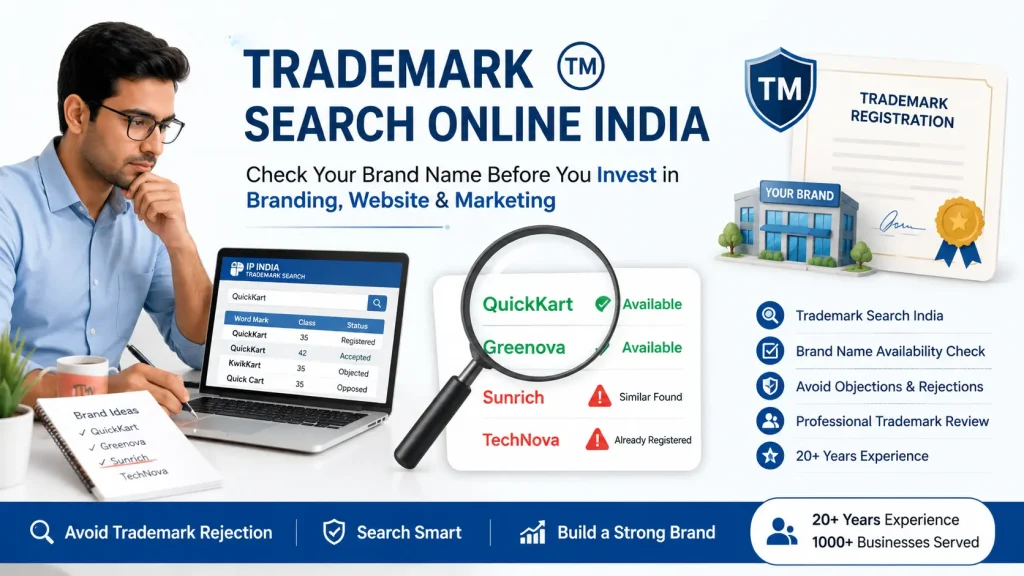
Trademark Search Online – Check Your Brand Before You Invest Your Money
Planning to launch a new business, product, app, website, software platform, restaurant, retail store, or startup? Before spending money on logo design, domain names, packaging, marketing campaigns, or social media promotion, ask yourself one important question:
Can your chosen brand name actually be registered as a Trademark in India?
Many business owners discover the answer only after investing months of effort and lakhs of rupees into branding. By that time, changing the name becomes expensive, stressful, and sometimes impossible.
A proper Trademark Search Online India helps identify possible conflicts before you launch your business. It gives you clarity about existing trademarks, similar sounding names, common industry terms, and legal risks that may affect your registration.
Why Smart Business Owners Search First and File Later
Trademark filing is only the final step. The real work starts much earlier when selecting the right brand name.
A weak brand name may look attractive from a marketing perspective but can face objections from the Trademark Registry because it is too common, descriptive, similar to another brand, or lacks distinctiveness.
On the other hand, a carefully selected trademark becomes a valuable business asset that can be legally protected for years and build trust among customers.
The goal is not simply to file a trademark application. The goal is to choose a brand that can successfully pass examination, obtain registration, and create long-term goodwill for your business.
The Costliest Mistake Most Businesses Make
One of the most common mistakes we see is that business owners finalize a name based purely on personal preference.
They purchase a domain, print visiting cards, design packaging, create social media pages, and start promoting the brand before checking whether similar trademarks already exist.
Later, they receive an objection or discover a similar registered trademark. The result can be:
- Rebranding expenses
- Loss of marketing investment
- Packaging redesign costs
- Website modification expenses
- Customer confusion
- Delay in business expansion
- Potential legal disputes
A simple trademark search at the beginning can help avoid many of these issues and provide confidence before investing further.
A Real Experience From Our Trademark Practice
Recently, a Bangalore-based technology startup approached our office after finalising its brand identity and software launch plans.
During our trademark review, we identified multiple similar sounding trademarks already existing within the same business category. Although the spelling appeared different, the pronunciation was almost identical.
Had the founders proceeded without reviewing these conflicts, they could have faced objections after investing significant time and money into marketing and product development.
After conducting a wider trademark clearance review, we suggested alternative coined-word options and helped them select a stronger brand identity before filing.
Sometimes a few hours spent on trademark search can save months of future business problems.
How to Choose a Trademark That Has Higher Chances of Approval
Many trademark objections do not happen because the applicant failed to submit documents. They happen because the chosen brand name itself was weak from the beginning.
Before investing in logo design, packaging, website development, domain registration, advertising, or product launch, it is important to evaluate whether your proposed trademark has the characteristics of a strong and legally protectable brand.
A good trademark should not only sound attractive to customers. It should also be distinctive enough to stand out from thousands of existing trademarks already registered in India.
1. Avoid Generic Words That Describe the Product
Many business owners naturally choose names that directly describe their products or services because they believe customers will understand the business immediately.
Unfortunately, these are often the very names that face objections from the Trademark Registry.
For example:
- Best Furniture
- Quality Foods
- Fast Delivery
- Smart Software Solutions
These words simply describe the business and do not create a unique identity. Since every business in the same industry may want to use similar words, obtaining exclusive rights becomes difficult.
2. Be Careful With Common Surnames and Place Names
Using a family name, city name, district name, or geographical location may appear logical from a business perspective, but it often reduces the distinctiveness of the trademark.
Examples include:
- Bangalore Electronics
- Karnataka Traders
- Sharma Technologies
- Reddy Foods
Such names may face scrutiny because many other businesses can legitimately claim the right to use similar names.
3. Invented Words Usually Perform Better
The strongest trademarks are often words that did not exist before the brand was created.
These are known as coined or invented trademarks.
Well-known examples include:
- Kodak
- Xerox
- Accenture
Because these words are unique, they generally face fewer conflicts and are easier to protect legally.
For startups and new businesses, creating a distinctive coined word often provides a stronger long-term brand strategy than relying on common industry terms.
4. Don’t Finalize Only One Name
One of the biggest mistakes applicants make is becoming emotionally attached to a single trademark.
If that name encounters objections or conflicts, the entire branding exercise may need to be repeated.
Instead, prepare at least three to five alternatives before conducting a trademark search.
This approach allows you to compare availability, distinctiveness, pronunciation, and overall branding strength before making a final decision.
5. Think Beyond Today’s Business
Many trademarks look suitable for the current business model but create limitations when the company expands into new products or services.
A brand name should support future growth and not restrict the business to a narrow category.
For example, a company planning to enter multiple technology sectors may outgrow a highly specific product-based name within a few years.
Choosing a scalable brand name today can prevent expensive rebranding exercises tomorrow.
Before filing a trademark application, shortlist at least five possible names. Conduct text searches, phonetic searches, domain availability checks, social media availability checks, and industry reviews. The strongest trademark is often not the first name you think of — it is the name that can survive legal review, market competition, and future business expansion.
The 7-Step Trademark Search Process Used Before Filing in India
Many applicants believe trademark search means entering a brand name into the government portal and clicking the search button.
While that is a good starting point, it is rarely enough to assess the actual registration risk. A professional trademark review involves multiple levels of verification to identify potential conflicts before an application is filed.
The objective is simple: identify possible risks before investing money into a brand that may later face objections, opposition, or legal disputes.
Step 1: Check Exact Trademark Matches
The first review involves searching for identical trademarks already filed or registered within the relevant business class.
If the exact name already exists, the chances of successful registration may be significantly reduced.
For example, if a software company wishes to register “TechNova”, an exact search helps determine whether the same name already exists in the technology sector.
Step 2: Conduct a Phonetic Search
Trademark examination is not limited to spelling alone. The Registry also evaluates how a brand sounds when spoken.
Many applications face objections because the pronunciation is similar to an existing trademark even though the spelling is different.
Examples:
- QuickKart and KwikKart
- Xcel and Excel
- Phynix and Phoenix
This is one of the most overlooked areas by first-time applicants.
Step 3: Review Similar and Related Brand Names
A trademark does not need to be identical to create a problem. Similar-looking names can also trigger objections.
Professional reviews examine variations, prefixes, suffixes, abbreviations, and combinations that may create consumer confusion.
A name that appears unique at first glance may still be considered deceptively similar by the Trademark Registry.
Step 4: Verify the Correct Trademark Class
India follows the Nice Classification system consisting of 45 trademark classes.
A search performed in the wrong class can create a false impression that the trademark is available.
Before filing, it is important to identify the correct goods and services classification applicable to the business.
Many startups operate across multiple categories and may require protection in more than one class.
Step 5: Check Domain Name Availability
A strong trademark should also support your online presence.
Before finalising a brand name, verify whether matching domain names are available for registration.
Customers today often search online first. If the domain is already owned by another business, future branding efforts may become difficult.
Ideally, your trademark, website domain, and social media handles should align as closely as possible.
Step 6: Review Social Media Availability
A brand’s identity extends beyond trademark registration.
Before launching a business, check whether the name is available across major social media platforms such as LinkedIn, Instagram, Facebook, X, and YouTube.
Securing a consistent digital identity helps customers recognise and trust the brand across different platforms.
Step 7: Evaluate Overall Brand Strength
The final stage is not a search but a strategic review.
Ask these questions:
- Is the name distinctive?
- Is it easy to pronounce?
- Can customers remember it easily?
- Does it support future expansion?
- Does it avoid common industry terms?
- Can it be legally protected?
A trademark should not simply be available today. It should be capable of becoming a valuable business asset over the next 10 to 20 years.
Many businesses focus only on whether a trademark can be filed. Experienced trademark professionals focus on whether a trademark can survive examination, opposition, market competition, future expansion, and long-term brand protection.
Top Trademark Mistakes That Lead to Objections and Rejections in India
Every year, thousands of trademark applications are filed in India. However, many applicants face objections, examination reports, or delays because of avoidable mistakes made before filing.
The good news is that most trademark problems can be identified and corrected during the brand selection stage itself.
The Registry does not reject a trademark simply because someone else has already registered it. Many applications face objections because the chosen brand name lacks distinctiveness or creates confusion in the market.
1. Selecting a Name That Directly Describes the Product or Service
One of the most common mistakes is choosing a name that merely explains what the business does.
Examples:
- Best Furniture
- Fresh Milk
- Fast Delivery
- Quality Foods
These names may help customers understand the business, but they are difficult to protect because every competitor may want to use similar words.
The Trademark Registry generally prefers distinctive names rather than descriptive terms.
2. Ignoring Similar Sounding Trademarks
Many applicants search only for exact spellings and miss phonetically similar trademarks.
For example:
- QuickKart vs KwikKart
- Xpert vs Expert
- Phynix vs Phoenix
Even when spellings differ, similar pronunciation can result in objections because consumers may become confused between the brands.
3. Choosing a Name Similar to a Famous Brand
Some business owners assume that changing one or two letters is sufficient to create a unique trademark.
Unfortunately, this approach often creates immediate problems.
Examples such as “Gooogle”, “Amazoon”, or “Applle” are unlikely to succeed because well-known brands enjoy broader legal protection across multiple industries.
4. Using Common Surnames
Family names are frequently selected because they carry personal significance.
However, common surnames such as Sharma, Reddy, Patel, Rao, Gupta, or Singh may face objections if they do not possess sufficient distinctiveness.
A unique brand identity is generally easier to register and protect.
5. Using City, State, or Geographic Names
Businesses often wish to showcase local identity through names such as:
- Bangalore Technologies
- Karnataka Traders
- Mysore Foods
- Delhi Enterprises
While these names may appear attractive, geographical terms alone are generally weak trademarks because they describe a location rather than a unique business source.
6. Filing in the Wrong Trademark Class
Many applicants conduct a search in one class but actually operate in another.
As a result, they may wrongly conclude that a trademark is available.
Proper class identification is critical because trademark rights are often linked to specific goods and services.
7. Falling in Love With the First Name Idea
Entrepreneurs often become emotionally attached to their first choice of brand name.
When objections arise, they continue pursuing the same name despite significant risks.
A smarter approach is to shortlist multiple alternatives and evaluate each one objectively.
The strongest brand is not always the first idea. It is often the one that passes legal review with fewer risks.
8. Ignoring Future Business Expansion
A name that works today may create limitations tomorrow.
For example, a business selling only software today may later expand into consulting, training, artificial intelligence solutions, or international markets.
Choosing a broader and scalable trademark can support long-term growth without requiring future rebranding.
9. Copying Market Trends Instead of Creating Identity
Many businesses try to imitate successful brands in the hope of attracting customers quickly.
However, imitation often weakens trademark protection and increases the risk of objections.
A unique identity is usually more valuable than a similar-looking brand.
10. Filing Without a Proper Trademark Search
Perhaps the most expensive mistake is filing a trademark application without conducting a detailed review.
A filing fee may be relatively small compared to the overall investment made in branding, packaging, website development, advertising, marketing campaigns, and customer acquisition.
Without proper due diligence, businesses may discover conflicts only after substantial resources have already been invested.
Most trademark objections can be traced back to decisions made before filing. Spending time on trademark search, brand evaluation, class verification, and distinctiveness review can significantly improve the chances of successful registration and reduce future business risks.
Why a Trademark Search Report Can Save Lakhs of Rupees Later
A trademark search is not merely a legal formality. It is a business risk assessment exercise.
Before spending money on product packaging, software development, website creation, digital marketing, franchise expansion, signboards, brochures, social media campaigns, and customer acquisition, it is wise to understand whether the chosen brand can realistically survive trademark examination.
The cost of changing a brand after launch is often many times higher than the cost of conducting a professional trademark review before filing.
The best time to identify a trademark problem is before the launch, not after customers already know your brand.
Understanding Trademark Search Results in India – What the Status Really Means
Many applicants perform a trademark search on the IP India portal and immediately become confused by the various status descriptions displayed in the results.
A common misconception is that every similar trademark automatically blocks a new application. In reality, the legal impact depends on the trademark’s current status, class, usage, reputation, and overall similarity.
Understanding search results correctly can prevent unnecessary panic and help you make informed decisions before filing your trademark application.
Registered Trademark
A Registered Trademark has successfully completed the registration process and enjoys statutory protection under the Trade Marks Act.
If a similar registered trademark exists in the same business category, your application may face objections or opposition depending on the level of similarity.
This is why simply checking whether a name exists is not enough. The degree of similarity and the nature of goods or services must also be reviewed.
Accepted and Advertised
An Accepted and Advertised trademark has cleared examination by the Trademark Registry and has been published in the Trademark Journal.
During this stage, third parties are given an opportunity to oppose the trademark if they believe it affects their rights.
Although registration has not yet been granted, such trademarks should be carefully reviewed before adopting a similar brand.
Objected Trademark
An Objected status means the Trademark Examiner has raised concerns about the application.
Common reasons include:
- Similarity with existing trademarks
- Lack of distinctiveness
- Descriptive nature of the trademark
- Use of generic terms
- Incorrect classification
Many applicants assume an objected trademark is dead. That is not always true.
A strong reply and supporting evidence may still result in registration.
Opposed Trademark
An Opposed trademark means a third party has formally challenged the registration.
Opposition proceedings can take considerable time and may involve legal submissions, evidence, hearings, and negotiations.
If a similar trademark is already facing opposition, additional investigation is usually advisable before proceeding with a related brand.
Abandoned Trademark
An Abandoned status generally means the applicant failed to complete procedural requirements, missed deadlines, or did not respond to Registry communications.
Many entrepreneurs mistakenly assume abandoned trademarks are completely free for use.
However, caution is necessary because the original business may still be actively using the brand in the marketplace and may possess common law rights through prior use.
Therefore, an abandoned trademark should always be reviewed carefully before adoption.
Withdrawn Trademark
A Withdrawn trademark indicates that the applicant voluntarily decided not to continue with the application process.
The reasons may vary, including business restructuring, branding changes, settlement with another party, or commercial decisions.
Even though the application is no longer active, market usage should still be investigated before proceeding.
Removed Trademark
A Removed trademark generally indicates that the registration was not renewed within the prescribed time and was removed from the Register.
While this may create opportunities for new applicants, prior market reputation and ongoing business usage should still be verified.
A trademark removed from the register does not automatically mean the brand has disappeared from the marketplace.
Proposed to be Used vs User Claimed
During trademark searches, you may also notice whether an applicant has claimed prior usage or filed the application on a “Proposed to be Used” basis.
A trademark with documented prior use often enjoys stronger protection than a recently filed application with no commercial use history.
This factor becomes particularly important when assessing potential conflicts and enforcement rights.
Trademark search is not about counting similar names. It is about understanding which marks create actual legal risk. Two identical-looking search reports may produce completely different conclusions depending on trademark status, class coverage, reputation, prior use, and market presence.
Can You Register a Trademark If Similar Results Already Exist?
In many cases, the answer is not a simple Yes or No.
A professional review generally examines:
- The trademark status
- The trademark class
- The level of phonetic similarity
- The visual similarity
- The nature of goods or services
- The reputation of the earlier trademark
- Whether prior use rights exist
This is why two businesses may receive completely different outcomes even when similar trademarks appear in the search report.
A trademark search report should not merely tell you what exists. It should help you understand what is safe, what is risky, and what can realistically be registered.
Why a Professional Trademark Search is Different From a Free Online Search
The IP India Trademark Search Portal is an excellent starting point for checking trademark availability. Anyone can access the portal and perform a basic search.
However, many business owners discover that finding a trademark and understanding a trademark are two completely different things.
The government portal shows data. A professional trademark review helps interpret the data and identify practical risks before you invest money into branding.
A free search tells you what trademarks exist. A professional search helps determine whether your chosen trademark has a realistic chance of registration.
What Most Business Owners Do
A common approach is:
- Search the exact name
- See no identical result
- Assume the trademark is available
- Proceed with filing
Unfortunately, trademark examination does not stop at exact matching.
The Registry also reviews pronunciation, visual appearance, market confusion, distinctiveness, class overlap, and legal rights of existing trademark owners.
This is why some applications receive objections even when the exact name was not found during a basic search.
Free Trademark Search vs Professional Trademark Review
| Basic Online Search | Professional Trademark Review |
|---|---|
| Checks exact words | Checks exact, phonetic and similar trademarks |
| Focuses on one search result | Analyses overall registration risk |
| Limited interpretation | Reviews legal implications of results |
| May overlook class issues | Verifies correct trademark class selection |
| No branding strategy review | Evaluates long-term brand protection potential |
| No digital review | Checks domain and digital branding opportunities |
The Hidden Risks a Basic Search Often Misses
Many trademark objections arise from factors that are not immediately visible to first-time applicants.
These may include:
- Phonetically similar trademarks
- Previously used trademarks
- Cross-class conflicts
- Well-known brand protection issues
- Descriptive or generic wording
- Weak trademark distinctiveness
- Potential opposition risks
Identifying these risks before filing often saves significant time, effort, and future legal expenses.
A Trademark Filing is Easy. Choosing the Right Trademark is Difficult.
Today, filing a trademark application can be completed online within minutes.
The challenge is not the filing process.
The real challenge is selecting a trademark that can successfully pass examination, avoid objections, withstand competition, and support business growth over many years.
This is where experience often makes the difference.
An experienced trademark professional reviews the trademark from the perspective of the examiner, competitor, customer, and future investor—not merely from the perspective of filing an application.
What We Review Before Recommending a Trademark
At Team IN Filings, our review typically focuses on practical business considerations rather than simply filing forms.
- Trademark availability assessment
- Distinctiveness review
- Phonetic similarity review
- Class identification
- Brand expansion potential
- Domain name considerations
- Risk of objections
- Risk of opposition
- Long-term brand protection strategy
The objective is to help businesses avoid costly mistakes before launching products, services, software platforms, manufacturing units, franchises, retail brands, or online businesses.
The cheapest trademark filing is not always the most economical option. If the chosen trademark fails after launch, the cost of changing signboards, websites, packaging, domain names, marketing materials, and customer awareness campaigns can be far higher than the cost of conducting a proper trademark review at the beginning.
Think Like a Brand Owner, Not Just an Applicant
A successful trademark is not simply a certificate issued by the Trademark Registry.
It becomes the identity of your business, the trust of your customers, the reputation of your products, and often one of the most valuable assets your company owns.
The best trademarks are not chosen by chance. They are selected after careful search, strategic review, and long-term business planning.
How to Search a Trademark Online in India
Before filing a trademark application, it is important to check whether a similar brand already exists.
A simple trademark search can help you avoid objections, delays, and future rebranding costs.
Remember: Search first, file later.
Step 1: Visit the Trademark Search Portal
Open the official IP India Trademark Search Portal.
This is the government website where trademark records are available for public search.
Step 2: Select Wordmark Search
Choose “Wordmark” from the search options.
This option helps you search brand names and business names.
Step 3: Select the Trademark Class
Choose the class related to your products or services.
India has 45 trademark classes covering different industries.
Step 4: Enter Your Brand Name
Type your proposed trademark name in the search box.
Try different spelling variations if possible.
Step 5: Enter the Captcha and Search
Enter the security code shown on the screen and click Search.
Step 6: Review the Results
Check whether similar trademarks already exist.
Pay attention to:
- Registered Marks
- Accepted Marks
- Objected Marks
- Opposed Marks
Step 7: Perform a Phonetic Search
Do not stop with a normal search.
Run a phonetic search to find names that sound similar to your brand.
For example:
- QuickKart
- KwikKart
- Quick Cart
These names sound similar and may create trademark issues.
If you find similar trademarks, do not assume your application will be rejected. The status, class, usage, and overall similarity must be reviewed before taking a final decision.
What to Do After the Trademark Search?
If your trademark appears unique, you can proceed with filing.
If similar marks are found, it is better to review the risks before investing money in branding, packaging, websites, marketing, and advertisements.
A few minutes spent on trademark search today can save months of problems later.
Before Finalising Your Brand Name, Check These 10 Important Points
Many trademark problems can be avoided by reviewing a few basic points before selecting a brand name.
Use this simple checklist before filing your trademark application.
☐ Is the name easy to read and pronounce?
☐ Is the name easy for customers to remember?
☐ Is the name different from existing brands in your industry?
☐ Have you checked the trademark search portal?
☐ Have you completed a phonetic search?
☐ Is the name free from famous brand similarities?
☐ Is the website domain available?
☐ Are social media usernames available?
☐ Can the brand support future business growth?
☐ Can the name become a valuable business asset after 5 or 10 years?
If your answer is “No” to several of the above points, it may be worth reconsidering the brand before filing the trademark application.
The Best Trademarks Are Built for the Future
Many successful businesses started with a small product or service but later expanded into new markets.
Your trademark should be capable of growing along with your business.
A name that works only for today’s product may become a limitation tomorrow.
Think beyond the next few months. Choose a brand that can support future products, services, locations, and business opportunities.
The strongest brands are not always the most descriptive names. They are the names that customers remember and trust over time.
Why Trademark Search is an Investment, Not an Expense
Some business owners view trademark search as an additional cost.
In reality, a proper trademark review can help avoid much bigger expenses later.
Imagine changing your:
- Website name
- Company branding
- Product packaging
- Sign boards
- Marketing materials
- Social media pages
- Customer awareness campaigns
All because a similar trademark already existed.
This is why experienced businesses conduct trademark searches before making major investments in branding.
The cost of choosing the wrong trademark is often much higher than the cost of conducting a proper trademark search.
Why Businesses Choose Team IN Filings for Trademark Search & Registration
A trademark application can be filed online in a few minutes. The real challenge is selecting a brand name that has a better chance of registration and long-term protection.
At Team IN Filings, we do not simply submit applications. We review the trademark from a practical business perspective and identify possible risks before filing.
Our team assists startups, software companies, manufacturers, traders, consultants, restaurants, healthcare businesses, educational institutions, and growing brands across India.
With over 20 years of experience, 1,000+ business clients, and a multidisciplinary team of CA, CS, Trademark, and Legal professionals, we help businesses protect their brand identity from the beginning.
Frequently Asked Questions (FAQs)
Is trademark search mandatory before registration?
No. However, conducting a trademark search before filing is highly recommended because it helps identify similar trademarks and reduces the risk of objections.
Can I do a trademark search myself?
Yes. Anyone can use the IP India Trademark Search Portal. However, understanding the legal risks behind the search results often requires professional review.
What if a similar trademark already exists?
It depends on the trademark status, class, reputation, pronunciation, and overall similarity. Similar results do not automatically mean rejection.
Can I register a trademark if another trademark is abandoned?
Possibly. However, the earlier owner may still be using the brand in the market. Additional review is advisable before proceeding.
How long does trademark registration take in India?
Trademark filing can usually be completed within 1–2 working days. Final registration may take several months depending on examination, objections, opposition, and registry processing timelines.
What is the government fee for trademark registration?
The government fee is generally ₹4,500 for Individuals, Startups, and MSMEs and ₹9,000 for other applicants, subject to applicable rules at the time of filing.
Can a company name protect my brand name?
No. Company registration and trademark registration are different. Trademark registration provides legal protection for your brand, products, and services.
Ready to Check Your Trademark?
Before investing in branding, packaging, website development, social media marketing, or product launch, ensure your brand name is reviewed properly.
A few hours spent on trademark search today may save months of objections, disputes, and rebranding expenses later.
Call or WhatsApp our team for a trademark search and registration review.
📞 7019827351
📧 team@teamindia.co.in
About the Author

Damodharaa R
CA | CS | Legal Advisor | Trademark Consultant
Damodharaa R has over 20 years of experience in Trademark Registration, Intellectual Property Protection, Company Law, GST, Income Tax, ROC Compliance, Legal Advisory, and Business Structuring.
He works with a team of professionals including Sreedhara S, Satish, Mahesh S, and Prakasha, assisting businesses across Bangalore and India.
Last Updated
This page was reviewed and updated to reflect current trademark search practices, trademark registration procedures, and practical brand protection considerations in India.
Last Updated: May 2026
Team IN Filings – Bangalore Office
Head Office:
#188, 1st Floor, B.T. Pura,
Sahakar Nagar,
Bengaluru – 560092
Email: team@teamindia.co.in
Phone: 7019827351
Working Hours:
Monday to Saturday
11:00 AM – 8:00 PM
Personal Meetings:
3:00 PM – 6:00 PM (Prior Appointment Preferred)
20+ Years Experience | 1000+ Clients Served | 5-Star Rated Professional Services
Disclaimer
Trademark search results provide guidance regarding potential availability and registration risks. Final acceptance, examination, objection handling, opposition proceedings, and registration decisions are subject to the provisions of the Trade Marks Act, 1999 and the discretion of the Trademark Registry.