
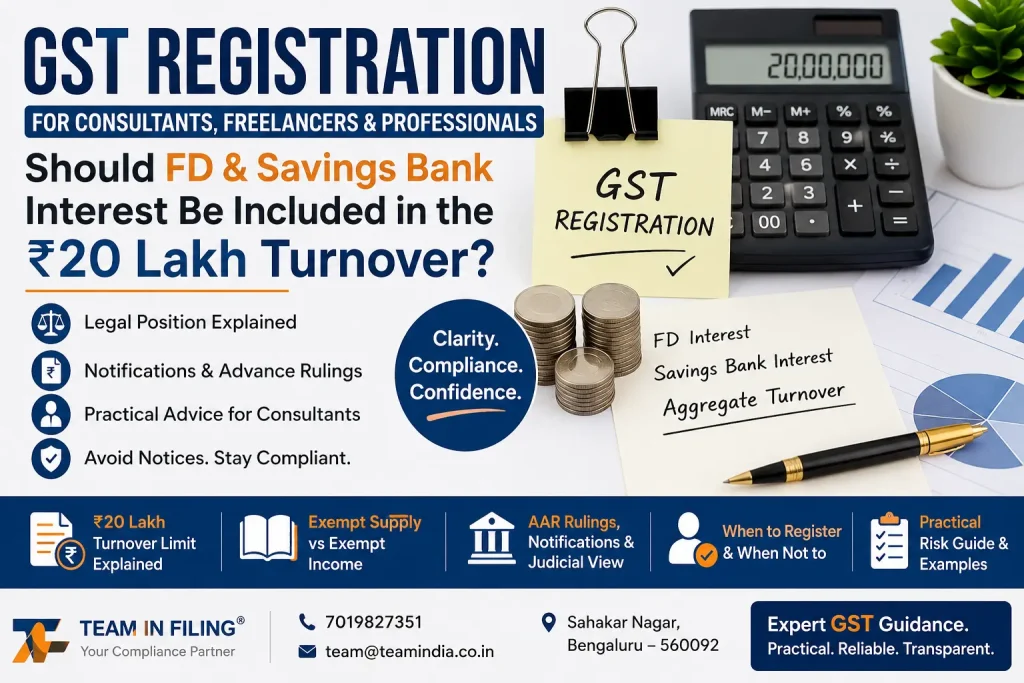
Confused About GST Registration Because of Your FD or Bank Interest?
Are you a consultant, freelancer, software professional, trainer, advisor, retired employee, engineer, architect or independent service provider earning less than ₹20 lakh from your professional services, but worried because your fixed deposit (FD) interest or savings bank interest pushes your total receipts above ₹20 lakh?
If yes, you are not alone. This is one of the most frequently asked GST questions we receive from business owners and professionals across Bangalore and Karnataka. Many people become confused after reading different opinions on Google, YouTube, WhatsApp groups and social media. Some say “Include FD interest.” Others say “Ignore personal bank interest.” Naturally, taxpayers are left wondering which advice is legally correct.
The confusion mainly arises because the GST law uses the term “Aggregate Turnover”, but it does not specifically explain whether a person’s personal savings bank interest or fixed deposit interest, which has no connection with their consultancy or professional activity, should automatically force them to obtain GST registration.
This article explains the issue in simple language. We will discuss the relevant GST provisions, Government notifications, Advance Rulings, judicial position and the practical approach followed by experienced GST professionals. More importantly, we will explain how a small consultant, freelancer or retired professional should practically deal with this issue without unnecessary fear or future compliance problems.
A Real-Life Example
Let’s understand this issue with a simple example.
Mr. Ravi, a software consultant from Bangalore, provides consultancy services to companies in Karnataka and other States. During the financial year, he earns ₹18.40 lakh as consultancy income. Since he has accumulated savings over the years, he also earns about ₹2.30 lakh as interest from his fixed deposits and savings bank accounts.
One day, while discussing GST with a friend, Ravi is told that FD interest is also part of “Aggregate Turnover”. He immediately becomes worried. His first thought is, “Have I violated the GST law? Should I have taken GST registration?”
He searches online for answers. Unfortunately, every website gives a different opinion. Some articles simply say “Include all exempt income.” Others say “Personal bank interest should not be counted.” Instead of getting clarity, Ravi becomes even more confused.
If you are facing a similar situation, don’t worry. The confusion does not arise because taxpayers have misunderstood the law. It exists because the GST provisions, exemption notifications and certain Advance Rulings have created different interpretations. Before deciding whether GST registration is required, it is important to understand what the law actually intends to cover and what constitutes your business turnover.
What Does GST Registration Actually Look At?
Many people believe that once their total money received during the year crosses ₹20 lakh, GST registration automatically becomes compulsory. Fortunately, that is not how the GST law works.
GST is primarily concerned with the turnover generated from your business or professional activities. In simple words, it examines the value of supplies made by a person in the course of running a business or profession. It is not an income tax where every type of income is automatically added together.
For example, a software consultant may earn consultancy fees from clients, receive interest from a savings bank account, earn dividends from investments, or even sell an old personal car. Although all these receipts may appear in the bank account, their legal nature is completely different.
This is where the confusion starts. The GST law uses the term “Aggregate Turnover”, which includes taxable supplies as well as certain exempt supplies. However, the law does not specifically clarify whether personal investment income such as savings bank or fixed deposit interest, having no connection with the person’s business activity, should be treated in the same manner as business receipts.
Because of this gap in the legislation, professionals, tax officers and Advance Ruling Authorities have expressed different views over the years. Therefore, understanding the nature of the income becomes more important than simply looking at the total amount credited to your bank account.
Who Is Actually Providing the Service?
Before deciding whether your FD interest or savings bank interest should be considered for GST registration, let us first understand one simple question.
When you keep your money in a savings bank account or fixed deposit, who is actually providing the service?
Most people immediately assume that since they receive interest, they must be providing some kind of financial service. However, in practical business terms, that is not how the transaction normally works.
When you deposit your personal savings with a bank, you are not carrying on the business of lending money. You are simply keeping your own money in a safe place. The bank, on the other hand, accepts deposits from thousands of customers, manages those funds as part of its banking business and pays interest according to the agreed terms.
In other words, the bank is carrying on the business of accepting deposits and providing banking services. A common consultant, freelancer, retired employee or professional is merely earning a return on his personal savings. His primary business continues to be consultancy, training, professional practice or advisory services—not banking or financing.
This is the main reason why many tax professionals believe that personal savings bank interest and fixed deposit interest should not automatically be treated in the same manner as business turnover for deciding GST registration. Such interest is generally an incidental return on personal investments and has no direct connection with the consultancy or professional services provided to clients.
At the same time, it is important to understand that the GST law contains a wide definition of Aggregate Turnover, and this has led to different interpretations by tax authorities and Advance Ruling Authorities. Therefore, before arriving at any conclusion, let us first understand what the GST law actually says.
What Does the GST Law Actually Say?
Under the GST law, a person is generally required to obtain GST registration when the aggregate turnover exceeds the prescribed threshold limit. For most service providers in Karnataka, this limit is ₹20 lakh in a financial year.
At first glance, this appears simple. However, the difficulty starts when we try to understand what exactly is meant by the words “Aggregate Turnover.”
The GST law does not use the words “business receipts” or “professional income.” Instead, it uses a much broader expression called Aggregate Turnover, which includes taxable supplies as well as certain exempt supplies made by a person.
This single definition has become the root cause of confusion. While it clearly covers the value of goods and services supplied during the course of business, it does not specifically clarify whether a person’s personal investment income, such as savings bank interest or fixed deposit interest, should also be treated as part of the turnover for GST registration.
As a result, many taxpayers read only the definition of Aggregate Turnover and conclude that every receipt credited into a bank account must be counted. Others believe that only receipts arising from the person’s business or professional activity should be considered. Both views find some support in the present legal framework, which is why this issue continues to generate debate.
In our practical experience, this confusion has affected thousands of consultants, freelancers, retired employees, trainers, architects, software professionals and independent advisors who have no intention of carrying on any banking or financial business but merely earn interest from their personal savings.
Does “Exempt Supply” Mean Every Exempt Income?
This is perhaps the most misunderstood concept under GST.
Many people read the definition of Aggregate Turnover, notice that it includes exempt supplies, and immediately assume that every exempt income must also be included while calculating the ₹20 lakh GST registration limit. However, these two expressions are not always identical.
GST is a tax on the supply of goods and services. It is not a tax on every type of income earned by a person. Therefore, before including any receipt in the GST turnover, the first question should be:
If the answer is Yes, the next step is to determine whether that supply is taxable, exempt, zero-rated or non-taxable. Such supplies are generally relevant while computing GST turnover.
However, if a receipt arises merely because you have invested your personal savings in a bank, received interest on a fixed deposit, earned interest on a savings bank account or received other passive investment income, an important legal question arises:
This is precisely where the present GST law becomes open to different interpretations. The Act provides a broad definition of Aggregate Turnover, but it does not specifically distinguish between business-related exempt supplies and incidental personal investment income that has no connection with the person’s professional activity.
As a result, one school of thought considers all exempt receipts for calculating the registration threshold, while another view is that only those receipts which arise from the person’s business or professional activities should be considered. This difference in interpretation has led to several Advance Rulings and conflicting professional opinions across India.
Why Was the ₹20 Lakh GST Limit Introduced?
Before deciding whether personal bank interest should be counted for GST registration, it is useful to understand why the Government introduced the ₹20 lakh registration limit.
The objective was simple. GST was designed to bring businesses and professionals into the tax system while giving relief to small service providers. The threshold was intended to reduce the compliance burden on individuals whose business activities were relatively small.
For example, a freelance software developer earning ₹12 lakh, a retired professor conducting training programmes worth ₹15 lakh, or a consultant earning ₹18 lakh should not immediately have to deal with GST registration, monthly compliance and return filing merely because they are carrying on a small professional activity.
The question therefore becomes more practical than technical.
This is exactly where different legal interpretations have emerged. While the GST law contains a broad definition of Aggregate Turnover, it does not expressly explain whether personal investment income, which is completely independent of the person’s consultancy or profession, should automatically result in compulsory GST registration.
In our professional opinion, the registration threshold should primarily measure the scale of a person’s business or professional activity. Personal savings parked in a bank are fundamentally different from providing consultancy, training, design, engineering, legal or other professional services to clients.
However, since the present law does not specifically distinguish between these situations, taxpayers should understand both the legal position and the practical compliance implications before making a decision.
Why Are There Different Opinions?
If you search this topic on Google, you will quickly notice that different Chartered Accountants, GST practitioners and tax experts have expressed different opinions. This is not because the law keeps changing every day. It is mainly because the GST provisions leave room for more than one interpretation in certain situations.
One group of professionals takes a strict legal interpretation. They read the definition of Aggregate Turnover under the GST Act, notice that it includes exempt supplies and therefore advise taxpayers to include all exempt receipts, including bank interest, while calculating the ₹20 lakh registration limit.
Another group adopts a purpose-based interpretation. According to this view, GST is a tax on business transactions and professional activities. Therefore, personal savings bank interest or fixed deposit interest, which has no connection with the person’s consultancy or profession, should not automatically be treated as business turnover for deciding GST registration.
Both views rely on different legal principles, which is why this issue continues to be debated among professionals.
This distinction is often overlooked, resulting in unnecessary confusion among consultants, freelancers, retired professionals and small service providers.
What Have Courts and GST Authorities Said?
Since GST was introduced in 2017, this issue has been discussed by GST Authorities, Advance Ruling Authorities (AARs) and tax professionals. However, the legal position is still not completely settled.
The GST Act contains the definition of Aggregate Turnover, but it does not specifically answer whether personal savings bank interest or fixed deposit interest, which has no connection with a person’s business or profession, should be counted for compulsory GST registration.
Because of this, different authorities have interpreted the law differently based on the facts before them.
What Is an Advance Ruling?
An Advance Ruling (AAR) is a decision given by a GST Authority on the specific facts presented by a particular applicant. Its purpose is to provide certainty to that applicant before or during the transaction.
Many taxpayers believe that an Advance Ruling becomes the law for everyone in India. That is not correct.
Under Sections 103 and 104 of the CGST Act, 2017, an Advance Ruling is generally binding only on the applicant who sought the ruling and the concerned GST officer. It does not automatically apply to every consultant, freelancer or business in the country.
Therefore, while an Advance Ruling provides valuable guidance on how the GST department may interpret a particular issue, it should not be treated as the final legal position for all taxpayers.
Has the Supreme Court Decided This Issue?
As of the latest update, there is no direct judgment of the Supreme Court of India deciding whether a consultant’s personal savings bank interest or fixed deposit interest, having no connection with his professional activity, must necessarily be included while determining the ₹20 lakh GST registration limit.
Similarly, there is no direct binding judgment of the Karnataka High Court settling this specific issue for all taxpayers.
This is one of the main reasons why different professional opinions continue to exist. Until there is a legislative amendment or a binding judgment from a higher court, the issue is likely to remain open to interpretation based on the facts of each case.
Team IN Filing’s Professional View
After analysing the CGST Act, IGST Act, exemption notifications, Advance Rulings and the current judicial position, we believe this issue should be examined from the perspective of the person’s business activity rather than merely the total credits appearing in the bank account.
In our considered view, personal savings bank interest or fixed deposit interest earned from investing one’s own money is fundamentally different from consultancy fees, professional charges or business receipts. A consultant does not become a provider of financial services merely because a bank pays interest on his personal deposits.
At the same time, we also recognise that the GST law contains a broad definition of Aggregate Turnover and that certain Advance Rulings have adopted a wider interpretation. Therefore, until the law is clarified by Parliament or settled by the Supreme Court, every case should be examined based on its own facts instead of applying a single rule to everyone.
Where the consultancy or professional income is comfortably below ₹20 lakh and the excess arises only because of incidental savings bank or fixed deposit interest, the issue remains legally debatable. However, where the combined receipts are approaching or substantially exceeding the threshold, obtaining GST registration is often the most practical and litigation-free approach.
When Do We Recommend GST Registration?
Every case is different. Instead of applying one rule to everyone, we first understand the nature of the income, the client profile and the future business plans. Based on our practical experience of advising consultants, professionals and business owners, we generally follow the below approach.
| Situation | Our Practical Advice |
|---|---|
| Consultancy Income ₹12 lakh + Savings Bank Interest ₹2 lakh | Normally, GST registration may not be required. Review the nature of receipts before taking a decision. |
| Consultancy Income ₹18 lakh + Savings Bank Interest ₹50,000 | Continue monitoring the annual receipts. GST registration is generally not an immediate concern. |
| Consultancy Income ₹19 lakh + FD Interest ₹2 lakh | Professional review is advisable, as different legal interpretations exist regarding incidental interest income. |
| Consultancy Income ₹19.50 lakh + FD Interest ₹4 lakh | For peace of mind and to avoid future disputes, voluntary GST registration may be the better compliance option. |
| Consultancy or Professional Receipts Above ₹20 lakh (excluding any legal ambiguity) | GST registration becomes mandatory under the normal threshold provisions, subject to applicable exemptions. |
Why We Sometimes Recommend Voluntary GST Registration
Many consultants ask us, “If the legal position is debatable, why should I voluntarily take GST registration?”
Our answer is based on practical business experience rather than theory.
If your consultancy income is steadily growing and your personal interest income takes the total receipts close to or above the threshold, obtaining GST registration often removes unnecessary uncertainty. Instead of worrying about future notices or departmental objections, you can continue your business with complete clarity.
In many consultancy assignments, the client is already registered under GST. The GST charged by you becomes Input Tax Credit (ITC) to the client, meaning it generally does not become an additional cost for them.
The only additional responsibility is maintaining GST compliance by filing periodic returns and keeping proper records. Compared to the time, cost and stress of future litigation, many professionals prefer this practical approach.
A Practical Experience from Our Office
Recently, a Bangalore-based consultant approached our office with exactly this concern. His consultancy income was below 20 Lac, but his fixed deposit interest resulted in the total receipts exceeding ₹20 lakh.
After reviewing the provisions of the GST Act, exemption notifications, Advance Rulings and the current judicial position, we explained both the legal interpretation and the practical compliance aspects. Instead of giving a one-line answer, we assessed the client’s future business plans, nature of consultancy services and overall risk profile before recommending the most suitable course of action.
Every taxpayer’s facts are different. Therefore, we believe that GST registration should never be decided merely by adding figures in a bank statement. Understanding the source of income, the purpose of the receipts and the applicable legal provisions is equally important.
Frequently Asked Questions (FAQs)
Below are some of the most common GST registration questions asked by consultants, freelancers, trainers, professionals and small business owners.
Is FD interest included in the ₹20 lakh GST registration limit?
The issue is legally debatable. While certain Advance Rulings have considered exempt interest while computing aggregate turnover, there is no direct Supreme Court judgment on whether personal FD interest, unconnected with business activity, must always be included. Professional advice is recommended before taking a decision.
Is savings bank interest included in GST turnover?
Normal savings bank interest earned on personal deposits is passive investment income. Whether it should be included for GST registration depends on the legal interpretation of aggregate turnover and the facts of each case.
I am a consultant providing services to another State. Is GST registration compulsory?
No. Small inter-State service providers are exempt from compulsory registration up to the prescribed threshold under Notification No.10/2017-Integrated Tax, subject to the applicable conditions.
Is GST registration compulsory below ₹20 lakh?
Generally, no. However, certain categories require compulsory registration irrespective of turnover. The nature of business and applicable GST provisions should always be verified.
Can I voluntarily obtain GST registration?
Yes. Many consultants and freelancers voluntarily register to improve business credibility, issue GST invoices, claim Input Tax Credit (where eligible), and avoid future disputes.
How much does GST registration cost?
At Team IN Filing, professional charges for GST Registration start from ₹3,000 (subject to document verification and business requirements).
What is the monthly GST filing cost?
GST return filing support starts from ₹1,000 per month, depending on the volume of invoices and compliance requirements.
How many days does GST registration take?
Normally, GST registration is completed within 1 to 7 working days, depending on GST Department processing time and document verification.
What documents are required for GST registration?
- PAN Card
- Aadhaar Card
- Passport-size Photograph
- Mobile Number & Email ID
- Business Address Proof
- Rental Agreement (if rented premises)
- Latest Electricity Bill / Property Tax Receipt
- Cancelled Cheque or Bank Statement
- Business Constitution Documents (if applicable)
Can retired employees take GST registration?
Yes. If they provide consultancy, training or professional services and are liable under GST, they can obtain GST registration like any other service provider.
Can freelancers and software consultants obtain GST registration?
Yes. GST registration is available for freelancers, IT consultants, software developers, architects, engineers, trainers, designers and all other eligible professionals.
Can I obtain GST registration even if my turnover is below ₹20 lakh?
Yes. Voluntary registration is permitted under the GST Act and is often beneficial for professionals dealing with corporate clients.
Should I wait until I receive a GST notice?
No. It is always advisable to review your turnover and GST liability proactively rather than waiting for a departmental notice.
Still Confused About GST Registration?
Every consultant, freelancer or professional has a different income pattern. A one-line answer from Chat Gpt AI, social media or YouTube may not be correct for your case.
At Team IN Filing, we review your income sources, business activities, GST provisions and practical compliance requirements before advising whether GST registration is necessary.
📞 Call: 7019827351
📧 Email: team@teamindia.co.in
Office:
Team IN Filing
Sahakar Nagar,
Bengaluru – 560092

Article Reviewed by GST Expert
Damodharaa R
Chartered Accountant | Company Secretary | Legal Advisor
With 20+ years of professional experience, Damodharaa R has advised 1,000+ businesses, consultants, freelancers, startups and MSMEs on GST, Income Tax, Company Law, ROC Compliance and Business Advisory. This article has been professionally reviewed to provide practical guidance based on the current GST law and compliance practices.