
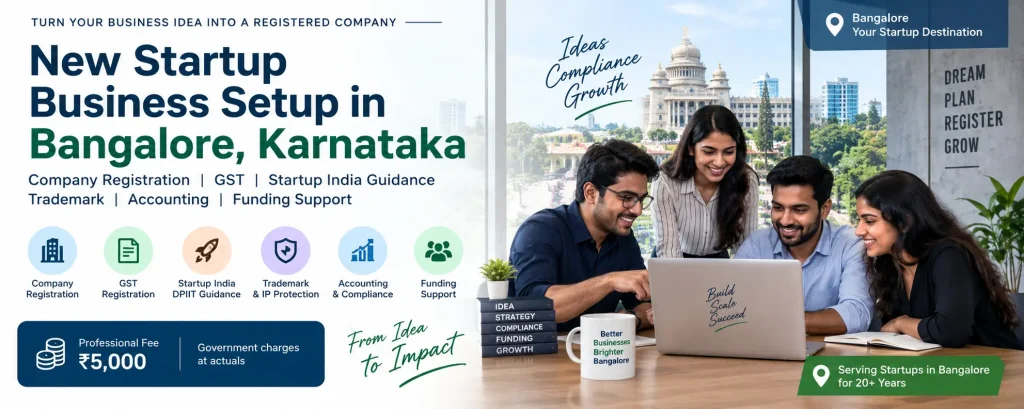
Have a startup idea but don’t know how to turn it into a legally structured business? This is where many first-time entrepreneurs in Bangalore get stuck. You may have completed your degree, developed a technology or business idea, arranged initial family funding, or already identified your first customers — but converting that idea into an operating company requires the right decisions on the business structure, founders, ownership, registered office, taxation, intellectual property and future funding.
The immediate risk is not simply choosing the wrong registration. A startup can face bigger problems later if its shareholding, founder arrangement, business activity, brand ownership or compliance structure is not planned properly at the beginning. The faster approach is to first discuss the business model with an experienced CA, CS and legal team and then incorporate the entity according to the way you actually intend to build the business.
At Team IN Filing,, we help founders take that first practical step. We can handle the startup company registration in Bangalore and the connected requirements such as DIN, DSC, PAN, TAN, MOA, AOA and applicable GST registration, and then continue with the requirements that arise after incorporation — including accounting, GST, trademark protection, payroll, ROC compliance, project reports and funding-related documentation.
If your objective is to build a scalable business and potentially bring investors into the company later, we can also examine whether a Private Limited Company is more appropriate for your proposed startup than simply selecting the cheapest registration option. If you are still deciding between different structures, our existing guide on One Person Company can also help you understand when a one-person structure may be relevant.
Our practical approach: You explain your startup idea in simple terms. We examine the proposed business activity, founders, ownership, initial capital, office arrangement and future plans. Then our CA/CS/legal team recommends the appropriate setup and takes care of the registration and immediate compliance requirements.
You do not need to wait until everything is perfect before starting. A new founder can begin with a lean and compliant setup and expand the structure as the business develops. In suitable circumstances, even the founder’s existing residential premises can be considered for the registered office, subject to the applicable documentation and legal requirements. This can save valuable initial capital that would otherwise be locked into commercial-office rent and deposits.
The important question is therefore not merely “How do I register a startup company in Bangalore?” The better question is: “How should I structure my startup today so that I can operate, protect my idea, raise funding and grow without having to rebuild everything later?” That is the problem our startup setup service is designed to solve.
Startup Company Registration and Startup India Recognition Are Not the Same
One of the first questions we hear from new entrepreneurs is, “If I register my Private Limited Company, will it automatically become a Startup India company?” The answer is no. These are two connected but separate steps. Company incorporation creates the legal business entity, whereas DPIIT Startup recognition is a separate recognition process for an eligible startup under the Startup India framework.
This distinction matters because many founders plan their business assuming that every new company automatically receives Startup India tax benefits, funding support or other concessions. That assumption can lead to incorrect financial planning. Before claiming any Startup India benefit, the startup’s entity type, incorporation date, business activity, innovation or improvement, scalability and other applicable eligibility conditions have to be examined.
Important: Do not treat the Certificate of Incorporation as proof that your company is entitled to every Startup India benefit. Incorporation and DPIIT recognition should be planned as separate compliance steps.
For an entrepreneur, the practical sequence is therefore straightforward: first establish the appropriate business entity, then examine whether the company qualifies for DPIIT Startup recognition and the particular benefits being targeted. If the objective is bank funding, seed funding, tax benefits, intellectual-property support or investor participation, each route can have its own eligibility requirements.
Who can generally qualify as a startup?
The current Startup India framework has specific eligibility conditions. A startup is generally required to be incorporated or registered in an eligible form, satisfy the applicable age and turnover limits, and demonstrate innovation, development or improvement of products, processes or services, or a scalable business model with potential for employment generation or wealth creation.
For the ordinary startup framework, the present turnover ceiling is ₹200 crore. A separate framework provides a higher ₹300 crore turnover threshold for recognised DeepTech startups, along with a longer eligibility period subject to the applicable conditions. Therefore, an entrepreneur should not rely on older articles stating that the startup turnover limit is ₹100 crore.
The age condition also needs attention. The general startup framework considers an entity within the prescribed period from its date of incorporation or registration, while DeepTech startups have a separate extended period under the current framework. We check the applicable rules at the time of making the recognition application instead of relying on an old checklist.
Why DPIIT recognition can matter to a new Bangalore startup
DPIIT recognition can become useful when a startup begins looking beyond incorporation. Depending on eligibility and the specific scheme, recognised startups may be able to access certain tax, intellectual-property, procurement, compliance and funding-related benefits. However, recognition should never be presented as a guaranteed government grant or automatic tax exemption.
For example, a founder planning to approach an investor or lender should prepare the company differently from someone who intends to operate a small family business without external investment. The shareholding pattern, founder contribution, business plan, financial projections, IP ownership and statutory records can become important as the startup grows.
This is why our Team IN Filing process does not end with uploading incorporation forms. We discuss where the founder wants the business to go — whether that means customer billing, government schemes, angel investment, bank finance, employee expansion or eventually a larger corporate structure — and then identify the registrations and professional support that make sense for that stage.
Think of the startup setup in 3 stages
Stage 1 – Build the legal entity: Choose the appropriate structure, reserve the name and complete incorporation.
Stage 2 – Establish the startup identity: Examine DPIIT recognition, trademark/IP protection, GST and other registrations applicable to the business.
Stage 3 – Prepare for growth: Put accounting, compliance, project reports, banking, funding documentation and investor-ready records in place.
If you are starting with a genuinely innovative product, technology or scalable service, this three-stage approach can prevent an avoidable problem: having a registered company but not having a business structure that is ready for the next funding or growth opportunity.
What Benefits Can a DPIIT-Recognised Startup Get?
Once the business is incorporated, the next question is usually, “What do I actually gain by getting Startup India recognition?” The answer is important because DPIIT recognition is not just a certificate to display on your website. For an eligible startup, it can open access to a range of government initiatives covering tax incentives, intellectual-property support, regulatory compliance, public procurement and funding avenues. However, each benefit has its own conditions and recognition alone does not mean that every benefit is automatically available.
The official Startup India framework currently identifies benefits including self-certification, intellectual-property support, income-tax exemption under Section 80-IAC, easier public procurement norms and easier winding-up provisions for eligible recognised startups. The practical value depends on what your business is trying to achieve. A technology startup may value patent and IP support, while a product company may be more interested in government procurement or a founder preparing for funding may focus on the financial and compliance structure. Startup India official portal lists these recognition benefits and related initiatives.
1. Income-tax benefit under Section 80-IAC
This is one of the most frequently asked-about startup benefits. An eligible DPIIT-recognised startup can apply for a 100% deduction of eligible profits for three consecutive financial years within the first ten years from incorporation, subject to the requirements of Section 80-IAC and the applicable approval process. It is therefore better to say “eligible startup may claim the benefit” rather than telling every newly registered company that its income will be tax-free for three years.
This distinction becomes particularly important when preparing a startup’s financial projection. If a founder is preparing a five-year business plan for a lender or investor, we should not simply reduce the projected tax liability to zero without first establishing whether the company will satisfy the applicable Section 80-IAC conditions and obtain the required approval.
2. Intellectual-property and patent support
For a technology-led startup, the business idea itself may not be the most valuable asset. The software, technology, process, invention, brand or other intellectual property developed around it can become the foundation of the business. DPIIT-recognised startups can access mechanisms for faster examination of patent applications and prescribed IP facilitation benefits. The Startup India framework also provides for an 80% rebate on patent filing fees, subject to the applicable rules.
This is why we encourage founders not to wait until an investor asks, “Who owns the technology and brand?” Before the startup becomes commercially valuable, the founder should examine trademark availability, IP ownership, founder arrangements and documentation concerning technology developed by founders, employees or contractors.
For the brand itself, our trademark team can separately assist with the search and registration process through our Trademark Registration Service in Bangalore. This is particularly relevant where the startup has already invested in a business name, logo, product name or digital brand.
3. Easier compliance in the early stage
Early-stage founders normally want to spend their time developing the product and acquiring customers, not dealing with unnecessary regulatory procedures. The Startup India framework provides eligible recognised startups with certain self-certification and compliance-related facilities, including provisions concerning specified labour and environmental laws. These facilities are subject to the applicable rules and should not be confused with exemption from all company-law, tax or GST compliance.
In practical terms, this means that Startup India recognition does not replace regular accounting, GST, payroll, ROC or income-tax compliance. A startup still needs proper books, invoices, statutory records and timely filings wherever applicable. Our role after incorporation is to keep these obligations organised so that the founder can concentrate on the business.
4. Government procurement can become a growth opportunity
A startup does not have to depend entirely on private customers. Eligible DPIIT-recognised startups can participate in government procurement opportunities, including access to the Government e-Marketplace and certain relaxations relating to prior experience, turnover and earnest money deposit, subject to the procurement rules and conditions applicable to the particular tender.
For a Bangalore startup developing a software product, technology solution, manufacturing product or specialised service, this can create another route to market. But the startup must still demonstrate the technical and commercial capability required for the particular procurement. Recognition may remove certain entry barriers; it does not guarantee that the startup will win a government contract.
5. Funding opportunities — recognition is not the same as guaranteed funding
This is where founders need the clearest advice. Startup India recognition does not mean the government will automatically transfer money into a newly incorporated company’s bank account. Funding programmes have their own eligibility criteria, application process, evaluation mechanism and permitted use of funds.
The Startup India ecosystem currently includes initiatives such as the Startup India Seed Fund Scheme, Fund of Funds for Startups, Credit Guarantee Scheme for Startups and Startup India Investor Connect. The Seed Fund Scheme, for example, is intended to support eligible early-stage startups for activities such as proof of concept, prototype development, product trials, market entry and commercialisation.
Therefore, when a founder approaches us saying, “I need funding for my startup,” our first question is not simply how much money is required. We want to understand what the money will be used for, what the startup has already developed, who the customers are, how revenue will be generated, how much the promoter is contributing and how the proposed funding will be repaid or deployed. That information determines which funding route may be worth exploring.
A practical example for a new Bangalore founder
Suppose two engineering graduates in Bangalore develop a technology-based service and have ₹5 lakh of family-backed initial capital. They do not yet have significant sales, but they have developed the product and prepared a commercial plan.
Instead of simply incorporating the company and immediately asking a bank for a large loan, we would look at the founder shareholding, company structure, IP ownership, trademark, initial capital, GST requirements, accounting system, business projections and project report. The founders can then approach the appropriate bank, government scheme, incubator or investor with a much more organised proposal.
The difference is simple: registration gives you the legal entity; proper startup structuring prepares that entity to do business.
6. The benefit is greater when the startup is planned before incorporation
The biggest mistake we see in early-stage businesses is treating registration as the finish line. It should actually be the beginning of the company’s formal business journey. If the founders know from day one that they want to raise investment, protect technology, hire employees, obtain bank finance or eventually build a large company, the initial structure should be created with those objectives in mind.
That is where our CA, CS and legal involvement becomes useful. We do not merely complete incorporation forms. We help the founder understand what should happen immediately after incorporation and which benefits or registrations are genuinely relevant to the business rather than adding registrations that have no practical value.
Can a New Startup Get Funding Before It Has Sales?
Yes, you can approach suitable funding or loan schemes even at an early stage, but approval is never automatic merely because the company is newly registered or has Startup India recognition. For a new business without invoices or customer sales, the bank or funding agency will usually want to understand the promoter profile, business model, project cost, proposed use of funds and repayment or commercial viability.
This is where a properly prepared startup project report becomes important. We help prepare the business plan, estimated investment, revenue projections, operating expenses, promoter contribution and proposed repayment structure so that the founder has a clear document to present to the appropriate bank, government scheme, incubator or funding channel.
Practical advice: If you need only initial working capital, start with a realistic project cost and promoter contribution. If you are seeking a larger amount, establishing genuine business transactions, proper GST billing and organised accounts can make the subsequent funding proposal stronger.
We can also examine whether the proposed business may fit an appropriate MSME, Mudra, startup or other business-finance route. The actual scheme depends on the nature of the business, amount required, promoter profile and current eligibility conditions.
Our job is not to promise a loan. Our job is to make your startup legally compliant and professionally prepared so that you can approach the right funding channel with a credible proposal.
What Documents Are Needed for Startup Company Registration?
The initial checklist is simple. You do not need to prepare a large file of documents before speaking to us. We first understand your business idea, founders, proposed ownership and office address, and then tell you exactly what is required.
- Brief business idea: What you are planning to sell, develop or provide.
- Proposed company name: Preferably one unique name, with alternatives if required.
- Minimum two founders/directors: For a Private Limited Company, the proposed structure normally starts with at least two members/directors.
- PAN and Aadhaar/identity documents of the proposed directors.
- Recent photograph of the proposed directors.
- Recent bank statement/address proof and other KYC documents as applicable.
- Registered office proof: Your existing home or suitable rented premises can be considered, subject to the applicable MCA requirements.
You do not have to take a costly commercial office just to start the company. For many new Bangalore entrepreneurs, using an appropriate existing premises initially can preserve their limited startup capital for product development, employees and marketing.
Once the basic documents are received, our CA/CS team takes care of the remaining incorporation documentation and statutory process. The founders can focus on preparing the business rather than trying to understand every MCA form themselves.
Simple starting point: Send us your business idea, proposed name and founder details. We will tell you the next documents and the suitable registration structure before you proceed.
What Happens After Your Startup Company Is Registered?
Getting the Certificate of Incorporation is only the beginning. Once the company is registered, the founder has to open the business bank account, bring in the initial capital, set up accounting, issue proper invoices and complete the applicable statutory registrations and compliances.
If the startup is going to sell products or services, we also advise on GST registration, billing, accounting and regular GST compliance wherever applicable. This is especially important when the founder wants to approach banks or investors later, because properly maintained books and business transactions provide useful evidence of how the company is operating.
Our associated team can handle ongoing accounting and GST requirements through a structured service. Complete Accounting & GST Filing Services can be used where the startup wants its regular accounts and GST work handled professionally.
Protect your brand before you grow
Registering the company name does not by itself give complete protection to your brand, logo or product name. If the startup is investing in a distinctive brand, we recommend checking trademark availability and protecting the brand at the appropriate stage.
Our trademark team can assist with the registration and protection process through our Trademark Registration Service in Bangalore.
Our support continues as the startup grows
After incorporation, we can continue to support the startup with accounting, GST, payroll, ROC filings, trademark/IP, contracts, project reports and funding documentation. This gives the founder one professional team to coordinate the major compliance requirements instead of approaching different consultants for every stage.
Our objective: We do not want you to simply receive a company registration certificate. We want the new company to be ready to start billing, protect its brand, maintain proper accounts, meet compliance requirements and prepare for future growth or funding.
Build Your Startup Today With Tomorrow’s Growth in Mind
A startup may begin with two founders and a small amount of capital, but the business can change quickly once customers, employees or investors come in. Changing the ownership and legal structure later can be more complicated than planning it correctly at the beginning.
Before incorporation, we therefore discuss the proposed founder shareholding, capital contribution, roles of directors, business activity and future investment plans. If an investor is expected to enter later, the initial structure should leave room for the company to raise capital without creating unnecessary disputes between the original founders.
Keep your startup’s intellectual property with the business
If your startup is developing software, a technology product, unique process, brand or other intellectual property, ownership should be properly documented. A founder should not assume that incorporating the company automatically transfers every piece of IP created before or after incorporation.
We can help identify the appropriate trademark, IP ownership, confidentiality and contractual requirements so that the business has a clearer ownership trail when it later approaches customers, investors or strategic partners.
Prepare for investment without losing control unnecessarily
When outside investment is planned, investors normally want to understand who owns the company, what the company owns, how the shares are held and whether the statutory records are properly maintained. A clean corporate structure and proper financial records can make the due-diligence process much easier.
Our CA, CS and legal team can support the startup through these stages, including shareholding documentation, corporate compliance, accounting, statutory filings, contracts and IP protection. The objective is to allow the founders to concentrate on building the business while the legal and compliance foundation keeps pace with the growth.
Founder tip: If you already know that your startup may require investors, employee incentives, technology licensing or significant expansion, tell us before incorporation. The first shareholding and ownership decisions are easier to plan before the company becomes complicated.
How We Set Up Your New Startup Company in Bangalore
Starting a company should not become a long paperwork exercise for the founder. Once you share the basic details, our team takes the process step by step and keeps you informed about what is required at each stage.
Step 1 – Understand your startup
You explain your business idea, proposed activity, founders, expected investment and future plans. We identify the suitable entity and immediate registrations.
Step 2 – Finalise founders and company name
We review the proposed name, founder details, shareholding and basic incorporation requirements before filing.
Step 3 – Prepare incorporation documents
Our CA/CS team prepares and coordinates the required DSC, DIN, MOA, AOA, declarations, registered-office documents and MCA filings.
Step 4 – Complete company registration
After MCA processing, the company receives its incorporation documents along with the applicable PAN, TAN and other registration details.
Step 5 – Startup and business registrations
Where applicable, we proceed with GST and advise on DPIIT Startup recognition and other registrations relevant to the proposed business.
Step 6 – Start the business properly
We then assist with the bank account, accounting, GST compliance, trademark/IP protection, project report and future funding or compliance requirements.
How long does startup company registration take?
Our usual target for the incorporation process is around 6–8 working days, provided the documents and information are complete and government/portal processing is normal. The actual timeline can vary where there are issues with the proposed name, KYC, registered-office documents or MCA processing.
Do not confuse incorporation time with funding time. Your company can be incorporated within the normal registration timeline, but obtaining a bank loan, government funding or investor money is a separate process and depends on the concerned institution’s eligibility assessment and approval.
Startup setup at one place: Company registration is only the first milestone. Our Bangalore team can continue with the accounting, GST, trademark, ROC, legal and funding-support requirements as your business moves from an idea to an operating company.
Startup Company Registration Cost in Bangalore – Professional Fee ₹5,000
Our professional fee for new startup company registration is ₹5,000. Government and statutory charges are additional at actuals, depending on the entity structure, capital and applicable registration requirements. We keep these two components separate so that the founder knows what is being paid for professional work and what is payable to the government.
The ₹5,000 professional service covers our assistance with the startup incorporation process and preparation/coordination of the applicable incorporation documents. Depending on the structure and requirements, this includes support relating to DSC, DIN, MOA, AOA, PAN, TAN and the incorporation process. GST registration and other registrations are handled where applicable and as agreed for the particular startup.
What you get at the initial setup stage
- Startup/company incorporation support
- DSC and DIN assistance
- MOA and AOA preparation
- PAN and TAN process
- Registered-office documentation guidance
- GST registration support where applicable
- Basic post-incorporation guidance
Why keep the cost transparent? New founders generally have limited initial capital. That money is better used for product development, employees, marketing, technology and customer acquisition than being spent on unnecessary registrations or inflated professional charges. We therefore first identify what the startup actually requires and then proceed with the applicable registrations.
If you are not yet ready for a Private Limited Company, do not register one simply because someone calls every new business a “startup.” We can first understand your business model and discuss whether a Private Limited Company, LLP or another suitable structure makes commercial and legal sense.
Simple starting point: Tell us your business idea, number of founders and proposed investment. We will explain the suitable structure, approximate government charges and the registration process before you proceed.
Private Limited Company or LLP – Which Is Better for a Startup?
If your plan is to bring in investors, issue shares, build a larger team or scale the business substantially, a Private Limited Company is often the structure founders consider first. An LLP can be suitable where the business is closely held and the founders prefer an LLP structure. The right choice depends on your business model and future plans.
Do not choose the entity only because its registration cost is lower. We first understand your proposed business, founders, ownership, funding requirement and growth plan and then advise on the appropriate structure.
Startup Compliance After Company Registration
Once the startup is incorporated, regular compliance begins. Depending on the entity and business activity, this can include accounting, GST returns, income-tax compliance, payroll, ROC filings, statutory records and other applicable registrations.
Missing these requirements can result in additional fees, notices and difficulty during future bank or investor due diligence. Our CA and CS team can manage the ongoing compliance so that the founder can concentrate on customers and business growth.
For startups that want their bookkeeping and GST handled regularly, our associated team provides Complete Accounting & GST Filing Services.
Protect Your Startup Brand, Technology and Intellectual Property
Your company registration does not automatically protect your brand name, logo, product name, software, invention or other intellectual property. If you have invested time and money in developing something unique, protection should be considered before the business becomes widely known.
We help founders examine trademark registration, IP ownership, confidentiality arrangements and related legal documentation. This becomes particularly important when investors, employees, developers or outside consultants become involved with the startup.
You can also explore our Trademark Registration Service in Bangalore for protecting the startup’s brand and business identity.
Complete Support After Startup Registration
Registering the company is only the first step. Once your startup is incorporated, you may need support with the business bank account, accounting, GST, payroll, ROC compliance, trademark, contracts and funding documentation. Handling these together helps the founder avoid approaching different professionals for every small requirement.
We continue to support the startup as it moves from registration to actual business operations. If you are looking for regular accounting and GST assistance, our Complete Accounting & GST Filing Service can be continued after incorporation.
Prepare Your Startup for Bank Finance and Future Investment
A good business idea alone is generally not enough when approaching a bank or investor. They want to understand what the business does, how much money is required, where the money will be used, expected revenue, expenses and repayment or growth potential.
We can assist with the preparation of a startup project report and financial projections based on the proposed business. This gives the founder a structured document for approaching suitable banks, government schemes, incubators or investors. Funding remains subject to the concerned institution’s eligibility and approval.
Where the startup has a larger long-term objective, we can also advise on maintaining proper corporate records, shareholding and financial discipline from the beginning so that future investor due diligence becomes easier.
From Startup Registration to Long-Term Business Growth
Our objective is not to complete incorporation and leave the founder to manage everything alone. We look at the startup as a continuing business journey: business idea → company registration → Startup India/DPIIT recognition where eligible → bank account → GST → trademark/IP protection → accounting → funding preparation → statutory compliance → business growth.
If your eventual ambition is to build a large company or reach the capital markets, the compliance foundation should start early. Our CA, CS and legal team can continue supporting the company as its shareholders, employees, revenue, contracts and regulatory requirements increase.
One professional team for the complete startup journey: Incorporation, tax, GST, accounting, trademark, company-law compliance, legal documentation and funding-support requirements can be coordinated through our Bangalore team.
Frequently Asked Questions About Startup Company Registration in Bangalore
Q. How much does startup company registration cost in Bangalore?
Our professional fee is ₹5,000. Government and statutory charges are additional at actuals, depending on the company structure, capital and applicable requirements.
Q. How many people are required to start a Private Limited Company?
A Private Limited Company can generally be incorporated with two or more members and two directors, subject to the Companies Act requirements.
Q. Can I register my startup using my home address?
In suitable cases, yes. An existing residential premises can be used as the registered office if the required address proof, ownership/occupancy documents and applicable consent documents are available.
Q. Does a new company automatically qualify as a Startup India company?
No. Company incorporation and DPIIT Startup recognition are separate. The startup must satisfy the applicable recognition conditions.
Q. Is every Startup India company exempt from income tax for three years?
No. The Section 80-IAC benefit is available only to eligible startups that satisfy the applicable conditions and approval requirements. Incorporation alone does not create an automatic three-year tax exemption.
Q. Can I get a bank loan even if my startup has no sales?
You can approach suitable funding channels at the early stage, but approval depends on the lender or scheme. A strong business plan, project report, promoter profile, financial projections and funding requirement can help present the proposal professionally.
Q. Do I need GST registration immediately after starting the company?
Not necessarily. GST registration depends on the nature of supplies, turnover, place of supply and other applicable conditions. We examine the startup’s activity before advising whether GST registration is required or commercially useful.
Q. Does company registration protect my startup brand?
Company incorporation does not provide complete trademark protection for your brand or logo. We recommend checking the brand and considering trademark registration at the appropriate stage.
Q. Can Team IN Filing help after company registration?
Yes. Our CA, CS and legal team can continue with accounting, GST, payroll, ROC compliance, trademark/IP, legal documentation, project reports and funding-support requirements.
Q. How long does startup company registration take?
Our normal target is around 6–8 working days, subject to document readiness, name approval and MCA/government processing timelines.
Why Choose Team IN Filing for Startup Business Setup in Bangalore?
A startup founder needs more than someone who can submit MCA forms. The company may soon need GST, accounting, trademark protection, payroll, ROC compliance, contracts, project reports and funding support. Having CA, CS and legal professionals involved from the beginning helps keep these requirements connected.
Team IN Filing has been serving Bangalore businesses for more than 20 years, with experience across company registration, taxation, GST, accounting, ROC/MCA compliance, trademark and business legal services. Our professional team works from Sahakarnagar in North Bangalore, with additional locations at Mathikere, Jakkur, Kalyan Nagar and Frazer Town.
Our approach is simple: understand the founder’s plan first, structure the business correctly, complete the registration and remain available as the business grows. This is particularly useful for first-time entrepreneurs who may not know which registrations, licences or compliances they actually need.
Startup support from one professional team
Company Setup: Private Limited Company / LLP and applicable registrations
Tax & GST: GST registration, accounting, returns and tax compliance
Brand Protection: Trademark and intellectual-property support
Funding Preparation: Project reports, financial projections and documentation
Ongoing Compliance: ROC, accounting, payroll and other applicable statutory requirements
Start Your Startup Journey With a Free Consultation
If you have a new business idea, technology concept, family-backed startup fund or plan to become an entrepreneur, you can begin by explaining your idea to us. We will discuss the suitable business structure, registration requirements and immediate next steps.
Professional fee for startup company registration: ₹5,000. Government and statutory charges are additional at actuals, depending on the applicable structure and requirements.
Ready to Start Your Business?
Share your startup idea and founder details with our team for an initial discussion.
Email: team@teamindia.co.in
WhatsApp / Contact: 7019827351
Head Office: Sahakarnagar, Bangalore – 560092
Monday–Saturday: 11:00 AM–8:00 PM
Personal meetings: 3:00 PM–6:00 PM by prior appointment
Related Startup and Business Services
After incorporation, you may also need: Accounting & GST Filing, Trademark Registration, Outsourced Accounting and Small Business with GST.
About the Author

Damodharaa R, CA, CS & Legal Advisor
Damodharaa R has 20+ years of professional experience in company law, MCA/ROC compliance, income tax, GST, intellectual property and business legal services, working with the Team IN Filing professional team in Bangalore.
Last Updated: September 2026. Startup India recognition, tax benefits, government schemes and funding eligibility are subject to the rules and conditions applicable at the time of application. Specific eligibility should be verified before relying on any government benefit.